Carbon or aluminium: which rollator is right for you?
How much weight does carbon really save? Compare lightweight rollators and their accessories to see when the extra cost makes sense for your everyday needs.
Published on
·14 min read
Image: saneq
A lightweight rollator can make loading it into a car easier, but carbon is not the only option. Here you can compare frame material, weight and equipment and find out when the extra cost may benefit your everyday life. What matters is finding a properly adjusted model that you can use and move easily.
A guide by the saneq editorial team, based on manufacturer specifications and general safety advice from the BFU (Swiss Council for Accident Prevention). Models and prices are from our range, as of October 2026. We have not carried out our own hands-on testing. The table distinguishes between total weight and weight without accessories and flags missing or unclear information.
How do carbon and aluminium differ in a rollator?
Carbon is a composite made from carbon fibres and plastic. It allows frames to be stiff and lightweight. The carbon composite itself does not corrode. That does not mean the whole rollator needs no maintenance: brakes, wheels, joints and connecting parts remain separate components that you must check and have serviced according to the instructions for use.
Aluminium is also a lightweight frame material. The models with documented aluminium frames listed here cost less than the carbon model. The weight of a finished rollator also depends on its design and equipment, though. A larger frame, different wheels or a basket change the comparison. Material and total weight are therefore not interchangeable terms.
Damage can also show up differently. Aluminium may visibly deform or become dented. With carbon, damage after an impact can be hard to spot from the outside. An unmarked surface therefore does not prove that the frame is intact. Equally, a dent in aluminium is not a harmless cosmetic flaw that you should simply ignore.
The material alone does not tell you the permitted load or how safe the rollator is for you. What matters is the approved use of the specific model. A stiff frame also says nothing about how comfortable a rollator feels on your usual routes. Assess the frame, wheels and handling together.
How much lighter is a carbon rollator really?
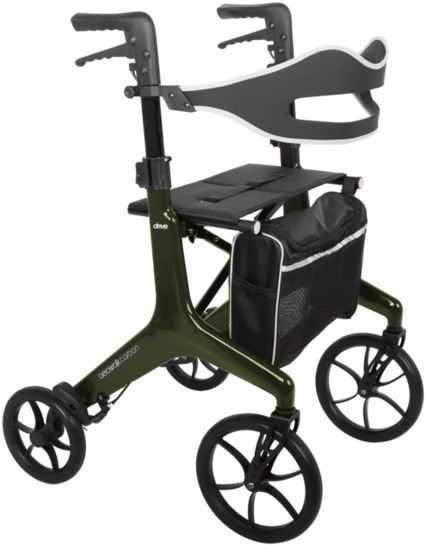
The AeroWalk Carbon is listed at 5.1 kg complete and 4.6 kg without accessories. The aluminium Nitro SL is listed at 6.3 kg complete and 5.5 kg without accessories. For a fair comparison, compare the complete weights. Reading only the lowest figure on a product page can give you the wrong impression of the difference.
The table shows a selection of lightweight everyday models available in the saneq range. “Complete” means the manufacturer’s stated total weight with the supplied equipment. “Not specified” means the manufacturer does not provide that figure, not that accessories weigh nothing. Prices apply to the versions listed, as of October 2026.
The result surprises many people: the aluminium TAiMA S-GT weighs 5.6 kg complete, just 0.5 kg more than the AeroWalk Carbon, but costs CHF 289.00 instead of CHF 549.00. However, it has a size S frame with an overall height of 76 to 86 cm, so it does not suit every body height. Carbon’s weight advantage is small in this pairing; it is more apparent when compared with standard and comfort models.
Everything you take with you adds to the weight you lift when loading. The manufacturer’s figure does not include a full shopping bag. Check which accessories you may remove according to the instructions and what you can stow separately. Compare the process as it actually happens in everyday life, including putting everything back together afterwards.
The manufacturer data specify the frame material only for the AeroWalk (carbon), the Nitro SL and the Gigo 2G (aluminium). This information is missing for the TAiMA models and the Nitro. Their weight also places them among the lightweight models, but we have not verified the material and have therefore left it out of the table.
Pay attention to the direction of folding: the Gigo 2G remains 61.5 cm wide. The smaller figure of 28 cm describes its folded dimension lengthways. For the Nitro, the figures in the table apply to XS and not automatically to every size. A narrow folded width alone also does not tell you whether a model will fit in your boot.
Carbon and aluminium frames side by side: material is one point of comparison. Assess weight, equipment and fit on the specific model. Illustrative image.
Image: saneq
When is carbon worth the extra cost?
If you often load the rollator into a vehicle
Think about the movements you repeat: folding, lifting, moving the rollator over the loading lip and setting it down again. A low total weight can help here. But the benefit also depends on where you can grip it and how easily you can hold the folded model. A number cannot replace trying this yourself.
Try your intended rollator with the equipment you want to keep. Ask someone to show you how to fold it and where the designated carrying points are. If someone else handles the loading, they should be there too. The extra cost makes more sense if the carbon model noticeably eases the actual movement for the person lifting it.
The steps involved also matter when taking a bus or train. Can you board without a step, manoeuvre and secure the rollator in the designated space? Or does someone accompanying you need to lift it? Check this situation. A carbon frame does not automatically make difficult boarding manageable. Plan the support you need regardless of the material.
If the combination of weight and design suits you
The AeroWalk combines a total weight of 5.1 kg, a maximum load of 150 kg and a folded width of 21 cm. That may be useful if you need all these features together. Load capacity is not an exclusive advantage of carbon, though: the listed TAiMA models are also rated for a maximum of 150 kg.
So assess the price of CHF 549.00 in relation to the whole model. The TAiMA S-GT costs CHF 289.00, but has a size S frame and must suit your required handle height. If both are suitable, check what difference you actually notice when lifting and using them. Appearance can matter too, if it is worth the extra cost to you.
If you rarely lift the rollator, saving weight is less important. Suitable handles, easy-to-use brakes and a less expensive model may then be the deciding factors. For a rollator that stays mainly at home, consider carbon only after checking manoeuvrability, space requirements and the storage you need.
What are the advantages of aluminium and less expensive alternatives?
The Nitro SL gives you a documented aluminium frame for CHF 199.00. The Gigo 2G costs CHF 119.00 and comes with a basket, tray, backrest and walking stick holder. This equipment belongs in the comparison: if you need it every day, the usefulness of the complete model matters. A lighter basic model without comparable equipment answers a different question.
Consider frame size too. The Nitro comes in sizes XS to L; the TAiMA range includes S-GT and M-GT, for example. Do not choose a small version just because of its weight. Handle height and seat height must suit you. Rule out the lightest candidate if it does not allow a suitable posture and safe operation.
Aluminium is readily recyclable. Without further data, however, that does not establish the overall environmental impact of a complete rollator. A practical question is more useful when buying: can you use the suitable model for a long time and have it serviced? Check the availability of wheels, brake parts and other accessories you need for your exact version.
This distinction also matters for repairs. A faulty part that is subject to wear is different from a damaged frame. Damaged carbon frames can rarely be repaired. That still does not make aluminium an invitation to straighten or weld a frame yourself. Have a specialist workshop check whether a repair is possible under the manufacturer’s instructions or whether a component needs replacing.
During your consultation, ask who handles servicing and repairs. A low purchase price is of little help if an important part cannot be sourced. Equally, a higher price cannot be justified simply by assuming a longer service life. The available data on our range do not provide that comparison.
What should you check with both materials?
The BFU (Swiss Council for Accident Prevention) recommends trying walking aids before buying, having them professionally adjusted and getting them checked regularly. This applies regardless of the frame material. Bring your everyday requirements to the consultation: where do you walk, what do you need to stow, who lifts the rollator and which movements are difficult for you? This puts the choice of material in the context of your daily life.
Check handle height, seat height and brakes on the adjusted model. The handles should suit your posture. You must be able to reach, operate and lock the brake levers. When trying the seat, secure the rollator with the parking brakes on firm, level ground. You can find detailed size guidance in “Which rollator is right for me?”.
Compare the folding mechanism too. Can you use it yourself and reliably check that it is locked? Try opening it as well as folding it. Accessories must not obstruct the intended process. Follow the instructions for the specific model: rollators that look similar do not necessarily fold or need to be carried in the same way.
Always check the maximum load before choosing a model. Consult the instructions to see how body weight and carried items are taken into account. The bag’s limit must be observed separately. The frame material is no reason to assume extra load capacity or to hang heavy objects from the handles.
Choose tyres to suit your usual routes and the options approved by the manufacturer. Carbon alone says nothing about which tyres suit you. The article “Rollator with pneumatic tyres” explains the difference between pneumatic tyres and puncture-proof wheels in more detail. For tight spaces, the guide “Rollator for the home” helps you assess your needs before settling on a material.
Which lightweight rollators can you compare more closely?
This selection covers the available models in the table, as of October 2026. The notes explain what comparison each model offers. Start with the versions that suit you, then assess equipment, weight and price. The order is not a ranking.
drive AeroWalk Carbon – a carbon example with a low complete weight and a narrow folded width. Check whether its handling is worth the extra cost to you.
DIETZ TAiMA S-GT – a compact size S frame and, at 5.6 kg complete, the lightest aluminium candidate in this selection. First check whether the handle height suits you.
DIETZ TAiMA M-GT – a size M frame with a steering damper and a kerb aid, for weighing up equipment against total weight.
drive Nitro SL – a documented aluminium frame with separate figures for complete weight and weight without accessories, allowing a direct material comparison with the AeroWalk.
DIETZ TAiMA M – another version with a size M frame, for comparing price, weight and the supplied equipment you need.
drive Nitro – worth considering for its choice of sizes. The table shows XS; check the weight and dimensions of the version that suits you.
drive Gigo 2G – an aluminium model with a basket and tray at the lower end of this selection’s price range. Take its different folding direction into account.
You can find further equipment features and other designs in the accompanying rollator comparison. Its model selection differs from the weight table in this article.
What are the frequently asked questions about carbon and aluminium?
The right model as a whole is what matters. Carbon may be useful if you lift the rollator often. Aluminium also offers lightweight models at lower prices. Compare the full equipment, fit and ease of use before paying more just for the frame material.
There is no single weight limit that suits everyone. Try the intended model with your own car and someone to help. What matters is the complete weight with your accessories, the loading lip, the grip points and your stable stance. You also need to be able to lift it back out in a controlled way.
You cannot tell from the material alone. The AeroWalk Carbon is rated for a maximum load of 150 kg. The model’s instructions for use remain the reference. That rating does not permit overloading or using a damaged frame.
Especially if you need to lift the model often and it also fits your rooms. If it mostly stays on the floor, check manoeuvrability, ease of use and storage first. “Rollator for the home” explains the details.
The tyres must suit your routes and the model’s intended use. The frame material does not decide that. You can find a comparison with care and handling advice in the guide “Rollator with pneumatic tyres”.
Still unsure? Tell our team when you need to lift the rollator, who helps you and which accessories you need. We can help you narrow down suitable versions and clarify missing information. Professional advice is recommended for personal adjustment and trying it out.
In the Rollators category, you can find the models with their current versions and prices. Use the material comparison alongside choosing the right size and handling.