Rollator for the home: measuring correctly and choosing the right one
Does the rollator fit through your doors and beside the bed? How to measure your home, compare narrow models and move safely at home with the rollator.
Published on
·8 min read
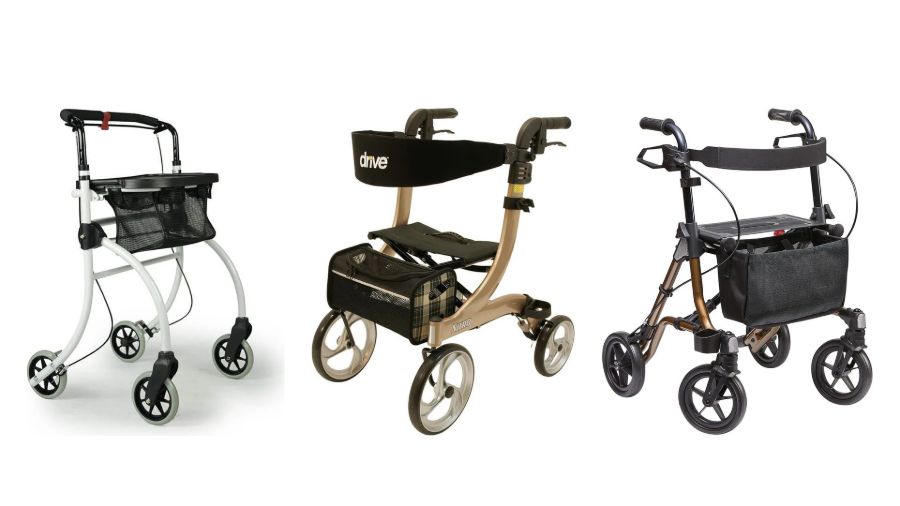
Image: Produktbilder: drive Medical, DIETZ
At home, you walk shorter distances, but through doors, corridors and between furniture. A rollator for indoor use, often called an indoor rollator, must therefore be narrow and manoeuvrable and fit your routines: from the bed to the bathroom, from the kitchen to the table. This guide shows you how to measure your home and which rollator is suitable for use at home.
It complements our guide Which rollator suits me?, where you will find information on handle height, weight and cost coverage. The basis is the manufacturer information from drive and DIETZ and the rollator guide from the Centre for Quality in Care (ZQP). We have not conducted our own practical test.
Measuring your home: doors, corridors and turning spaces
Take a metre and walk the routes you take daily with the rollator:
Open every door fully and measure at the narrowest point, i.e. between the door leaf and the opposite door frame.
Measure corridors and the passages between furniture, such as between the bed and wardrobe or between the table and the wall.
Check where you need to turn with the rollator, for example in the kitchen, bathroom or beside the bed.
Note door thresholds and steps, even small ones.
Consider the route at night, for example from the bed to the toilet.
For orientation: The Swiss standard SIA 500 for barrier-free buildings specifies a usable width of at least 80 cm for doors in residential buildings. This is a planning guideline for buildings, not a requirement for your rollator. Many existing homes have narrower doors. Therefore, your own measurement is decisive.
Compare this value with the overall width of the rollator and allow space for your hands on the handles. The folded dimension does not help here, as the rollator is unfolded when walking.
Narrow rollators compared
These models from our range are narrower than our other rollators, which are usually around 61 cm wide:
Values according to the manufacturer. In addition to the width, pay attention to the handle height: The Nitro in size XS is the narrowest at 52 cm, but its handles only reach up to 77 cm. Therefore, it is only suitable for small people. The TAiMA S-GT is also intended for smaller people. The Roomba is particularly short at 51.5 cm. The Migo 2G offers the greatest range in handle height. Also note the individual load limits of the bag, basket and tray.
Also try out the brakes: Can you comfortably reach the levers or the brake bar, and can you reliably operate and lock the brake?
A tray is practical at home for carrying dishes, a drink or laundry without having to let go of the handle. The Roomba has a large tray measuring 45 × 30 cm and a brake bar that you can operate and lock with one hand. It does not have a seat. If you need a break on your routes, plan for a chair with armrests or choose a model with a seat. Use a rollator seat only according to the instructions: on firm, level ground and with both brakes locked.
Observe the permissible load of the tray, basket or bag in the instructions for use. For example, the standard rollator Cristallo allows up to 5 kg each for basket and tray.
Eliminate tripping hazards in the home
The ZQP recommends arranging the home so that you can use the rollator safely:
Compensate thresholds with small ramps.
Remove thick carpets and secure carpet edges.
Rearrange furniture so that the paths are free and wide enough.
Also lay loose cables out of the way and illuminate the path at night, for example with a night light.
In everyday life: doors, turning and sitting down
Going through doors
If the door opens towards you, drive as close to the side as possible. Set the brakes and open the door. When stable, lift the rollator slightly by the handles, keeping the front wheels on the ground. Move it sideways in front of the opening and set it down completely again. Only then release the brakes and go through. If sideways is not possible, open the door frontally and walk backwards with small steps. Do not lean far over the rollator. Ask for help with heavy doors or if you are unsteady, or leave the door open.
Turning on the spot
Step further into the rollator when turning than when walking and turn with small steps. A short frame can make manoeuvring easier. Check with the intended model whether you can turn safely at your narrow points.
Sitting down and standing up
It is best to use a chair or armchair with armrests.
Approach the chair and turn so that your back is to the seat surface.
Walk slowly backwards until you feel the seat surface at your legs.
Set the rollator brakes before sitting down or standing up.
To stand up, slide forward, place one foot slightly under the chair and lean your upper body forward. Push yourself up with both hands from the armrests.
Grasp the rollator handles one after the other as soon as you are standing securely. Do not pull yourself up on the rollator.
In the bathroom and at the toilet, firmly mounted grab rails help. The rollator does not replace them.
A rollator for indoors and outdoors?
A narrow rollator with a seat like the TAiMA S-GT or the Migo 2G can cover both. If your routes outside are longer or uneven, while it is tight indoors, a second rollator can be useful: a short, narrow one like the Roomba for home and a model with larger wheels for outdoors. What to look for in the wheels is explained in our guide Rollator with pneumatic tyres.
All models with current prices can be found in our category Rollators.
Frequently asked questions about the rollator for the home
Wide enough to pass through your narrowest door and narrowest passages with some clearance for your hands. Measure the door fully open at the narrowest point.
Among the models compared here, the Nitro in size XS is the narrowest at 52 cm. Its handle height ranges from 71.8 to 77 cm. Roomba, TAiMA S-GT and Migo 2G are 57 or 58 cm wide. It is crucial that handle height and brake operation also suit you.
Not necessarily. A tray is often more useful indoors. If you need breaks on the go, a chair with armrests should be within reach, or you choose a model with a seat. Use the rollator seat only according to the instructions, on firm, level ground and with both brakes locked.
In Switzerland, basic insurance does not cover the purchase of a rollator, not even for indoor use. Which other organisations may help depending on the circumstances is explained in our guide Which rollator suits me?.
Still unsure? Our team is available by phone from Monday to Friday between 8 a.m. and 5 p.m. at +41 56 511 60 99. Please have the narrowest point of your home and your handle height ready.
Sources: Dimensions, weights and load capacities from the manufacturer information of drive and DIETZ, checked in September 2026. Home adaptation, doors, turning and sitting down according to the guide «Rollator – Tips for safe use» from the ZQP. Door width according to SIA 500 standard, quoted from hindernisfreie-architektur.ch.