How much does a rollator cost and who pays for it in Switzerland?
What a rollator costs at saneq, why compulsory basic health insurance does not pay and which organisations you can contact before buying: an overview for Switzerland.
Published on
·13 min read
Image: saneq
Do you need a rollator and want to know what costs to expect before buying? Here you will find price examples by type and the organisations responsible for possible funding in Switzerland. This will help you assess your budget and clarify cost coverage before you order.
A guide by the saneq editorial team based on official provisions and information sheets from the Information Centre for old-age and survivors’ insurance (AHV) and disability insurance (IV), and the City of Solothurn’s specialist social insurance service; prices from our range, as of October 2026; not legal advice. The selection of models is not based on our own practical testing. The legal provisions and the assessment of your individual case are decisive.
How much does a rollator cost in Switzerland?
The price examples from our range extend from CHF 99.00 for a standard model to CHF 549.00 for a carbon model. The following table groups the twelve models by type. It shows saneq prices as of October 2026, not a general market price range or insurance contributions.
Among the lightweight everyday models, the examples cost CHF 119.00 for the Gigo 2G, CHF 199.00 for the Nitro SL and CHF 219.00 for the TAiMA M. The TAiMA M-GT and S-GT each cost CHF 289.00, while the Nitro is listed from CHF 339.00. Before ordering, check the current price of your chosen version.
Why do prices differ?
Frame material, weight, tyres and equipment help you understand price differences. An indoor model meets different requirements from an outdoor rollator or a model with forearm supports. First decide which type you need. Frame sizes also belong in the comparison; a similar price does not mean that two versions fit you equally well.
When comparing weight, use the same basis: the Nitro SL costs from CHF 199.00 and weighs 6.3 kg fully equipped. The AeroWalk Carbon costs from CHF 549.00 and weighs 5.1 kg fully equipped. Do not compare one model’s weight without accessories with another model’s total weight. Whether a lighter frame is worth the extra cost to you also depends on how often you lift the rollator.
Check what is included: a bag, basket, tray, back strap or walking stick holder may already be supplied. Allow for possible spending on accessories and spare parts. Pneumatic tyres also need maintenance. The information available does not allow a flat annual amount to be calculated for this.
Does health insurance pay for a rollator?
Compulsory basic health insurance does not contribute towards rollators. In the walking aids category, crutches for children and adults are reimbursed under the MiGeL (FOPH’s List of Aids and Appliances). This does not mean that every walking aid is covered. The City of Solothurn’s specialist social insurance service explicitly makes this distinction in its information sheet.
A medical prescription describes the need but is not a funding commitment. Even if another organisation rejects an application, this does not create entitlement to a rollator benefit under compulsory basic health insurance. In general, benefits for aids under the Health Insurance Act (KVG) are secondary to those under IV, AHV, accident insurance and military insurance.
Supplementary insurance (VVG) may provide a contribution towards aids. Your policy is what matters. Ask your insurer specifically about a rollator, the documents required and the possible contribution. Before ordering, have the insurer confirm whether your chosen provision is covered and to what extent.
IV, AHV or EL: which organisation is responsible for you?
First consider your personal circumstances. Previous provision through IV is just as important as the reference age or drawing the full AHV pension early. The table shows whom to contact and the limits of each benefit.
Personal circumstances
Responsible organisation
What applies to the rollator?
Compulsory basic health insurance under KVG
Your health insurer
No contribution towards rollators through compulsory basic health insurance.
Before the reference age, without drawing the full AHV pension early
IV office in your canton of residence
Have entitlement to a simple, appropriate and economical walking aid assessed. Rollators are provided on loan.
New need from the reference age or when drawing the full AHV pension early
IV office for assessment of AHV aids
The AHV list of aids does not include rollators.
Existing IV provision when moving to AHV
IV office, with your previous decision
Protection of acquired rights to the same extent, as long as the IV conditions continue to be met.
Receiving supplementary benefits (EL)
Responsible EL office
Reimbursement and eligibility conditions depend on the canton; ask the responsible EL office before buying.
Need resulting from an accident
Responsible accident insurer
Have entitlement assessed there first; simple and appropriate provision.
Need arising from the period covered by military insurance
Military insurance
Priority assessment based on the conditions in the individual case.
Existing supplementary insurance (VVG)
Your supplementary insurer
A contribution may be possible depending on the policy.
From the reference age or when drawing the full AHV pension early, without entitlement to aids under AHV or EL
Pro Senectute
Additional contributions or provision on loan may be possible; no legal entitlement.
No entitlement to aids under IV
Pro Infirmis
Contributions towards costs or provision on loan may be possible; no legal entitlement.
How are aids provided through IV?
Information sheet 4.03 lists rollators and walking frames as aids for everyday life, such as getting around, maintaining contact with others and self-care. IV assesses individual entitlement and a simple, appropriate and economical version. Where possible, aids come from IV equipment depots. For rollators, the Solothurn information sheet describes provision on loan. A model from the shop is therefore not automatically an approved provision.
What does protection of acquired rights mean when moving to AHV?
If you have already received aids through IV before reaching the reference age or drawing the full AHV pension early, your existing benefits may continue to the same extent. The IV conditions must continue to be met. Present your previous decision during the assessment. This is different from needing a rollator for the first time under AHV, whose list does not include rollators.
What applies to supplementary benefits?
Whether supplementary benefits reimburse illness and disability costs, and under which conditions, depends on the canton. Ask the responsible EL office before buying. Two cantonal examples, as of 2026: in the canton of Solothurn, walking aids are not reimbursable through EL according to the City of Solothurn’s information sheet (August 2025), based on the RKEL, section 19 and annex 1. In the canton of Zurich, the Cantonal Social Welfare Office’s directives (as of 1 January 2026, section 2.4.8.2) provide for a maximum rollator reimbursement of CHF 350 for people of AHV pension age who live at home and are entitled to additional benefits (ZL). The responsible office decides whether you meet the conditions. Costs already covered by IV or another insurer are not covered a second time through EL.
What applies after an accident or under military insurance?
If your need results from an accident, first have your entitlement assessed by the responsible accident insurer. Item 12.02 in the annex to the Accident Insurance Aids Ordinance lists wheeled walkers and walking frames. Provision must be simple and appropriate; aids may be supplied for you to own or on loan. Clarify which benefit applies in your case before obtaining the aid.
If the need arises from the period covered by military insurance, entitlement must be assessed there first. The responsible organisation decides based on the conditions in the individual case. There is no list of aids from which you could infer a standard rollator benefit.
What should you do before buying a rollator?
Here is how to proceed: Clarify your needs and funding in this order.
Clarify your needs. Discuss with your doctor what you need the rollator for. Ask them to explain the need and any prescription. Note down the requirements for your enquiry.
Identify the responsible organisation. Use the table to check which organisation to approach first. Mention any link to an accident, previous provision through IV and any early receipt of an AHV pension.
Submit your application before buying. For adults, IV specifies form 001.002 “Anmeldung für Erwachsene: Hilfsmittel” (application for adults: aids). Submit it to the IV office in your canton of residence. Ask the responsible organisation what additional documents it needs.
Wait for the decision. Clarify whether a loan device is planned, where you should obtain it and which costs you will have to pay yourself. Approval must match the provision you then arrange.
Discuss any unresolved funding. Check any existing supplementary insurance and ask the responsible EL office about reimbursement and eligibility conditions in your canton before buying. If you have no entitlement to aids under AHV or EL, you can contact Pro Senectute from the reference age or when drawing the full AHV pension early. If you have no entitlement to IV aids, Pro Infirmis may be a point of contact. There is no legal entitlement to this support.
Arrange the provision. Follow the agreed route for obtaining the aid. If you want to buy it yourself without a contribution, set your budget first and check the model, version and what is included. Keep the decisions and receipts.
Which models illustrate the price range?
These eight examples show different types and price levels in the saneq range, as of October 2026. The selection is not a list of models approved by an insurer. The brief notes explain why each model is included here.
drive Cristallo – from CHF 99.00: a standard model at the entry point of the price range, with a basket, tray and walking stick holder.
drive Gigo 2G – from CHF 119.00: an example of a lightweight rollator with an aluminium frame in the lower price range.
drive Nitro SL – from CHF 199.00: a comparison model weighing 6.3 kg fully equipped, if you want to consider price and weight together.
DIETZ TAiMA M – from CHF 219.00: another lightweight model with a mesh bag and walking stick holder for comparing equipment.
drive Roomba – from CHF 229.00: an example of an indoor model, with an overall width of 57 cm and a tray.
DIETZ TAiMA XC – from CHF 389.00: an outdoor model with pneumatic or soft PU tyres, to include different tyre options in the comparison.
drive Cristallo² with forearm supports – from CHF 399.00: a special design for support through the forearms. Have a professional assess whether it is suitable for you.
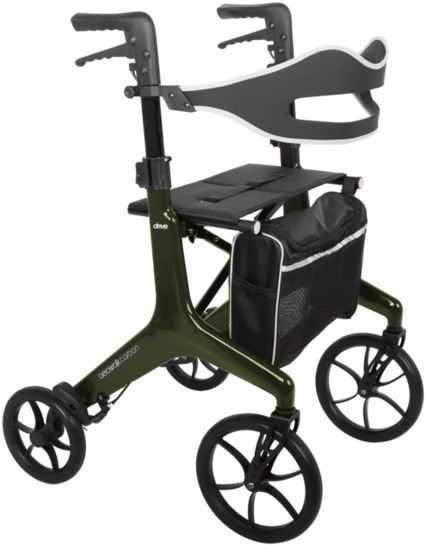
drive AeroWalk Carbon – from CHF 549.00: a carbon model weighing 5.1 kg fully equipped, as an example at the upper end of this selection from the range.
Which questions about price and cost coverage often remain unanswered?
There is no fixed price for a suitable rollator. Our examples range from standard models starting at CHF 99.00 to carbon models starting at CHF 549.00, as of October 2026. What matters is whether the type and equipment meet your needs.
Compulsory basic health insurance does not contribute. Existing supplementary insurance may provide a contribution depending on the policy. Before buying, ask about coverage and the documents required.
There is no reimbursement amount for rollators under compulsory basic health insurance. With supplementary insurance, any contribution depends on your contract. Have the extent of coverage confirmed; a prescription alone tells you nothing about it.
Compare intended use, type, weight and handling. A higher price alone does not tell you whether a model is suitable. Our rollator selection guide explains how to assess size and other requirements.
Rollators are not on the AHV list of aids. If you have already received aids through IV, have the protection of your acquired rights assessed. Existing benefits may continue to the same extent as long as the IV conditions are met.
Ask the responsible organisation about provision on loan, for example if your IV entitlement has been recognised. Pro Senectute or Pro Infirmis may help, but there is no legal entitlement to their support. If you receive a private rental offer, compare its total cost for the planned duration with buying. Provision on loan and private rental are different routes.
Still unsure? We can help with questions about type, weight and equipment. For funding, contact the responsible organisation. The guide “Which rollator is right for me?” helps you make your personal choice. If you need a wheelchair, you will find the applicable rules in the article “Who pays for a wheelchair?”.
Once your choice and funding are clear, you can buy rollators at saneq in our category and check the current price of your version.
Sources: AHV/IV Information Centre: information sheet 3.02 “AHV aids” and information sheet 4.03 “IV aids”, both as of 1 January 2024 (3.02, section 4 for Pro Senectute); ELG, article 14 paragraph 1 letter f and paragraph 2, as of 1 January 2026; cantonal examples checked in October 2026: City of Solothurn, specialist social insurance service: information sheet “Coverage of walking aid costs at the reference age”, as of August 2025, section on walking aids, and the canton of Solothurn’s RKEL, section 19 and annex 1; canton of Zurich: Cantonal Social Welfare Office directives on additional benefits to AHV/IV, as of 1 January 2026, section 2.4.8.2; FOPH: MiGeL; Pro Senectute Switzerland. Product information and price examples: saneq range, as of October 2026.