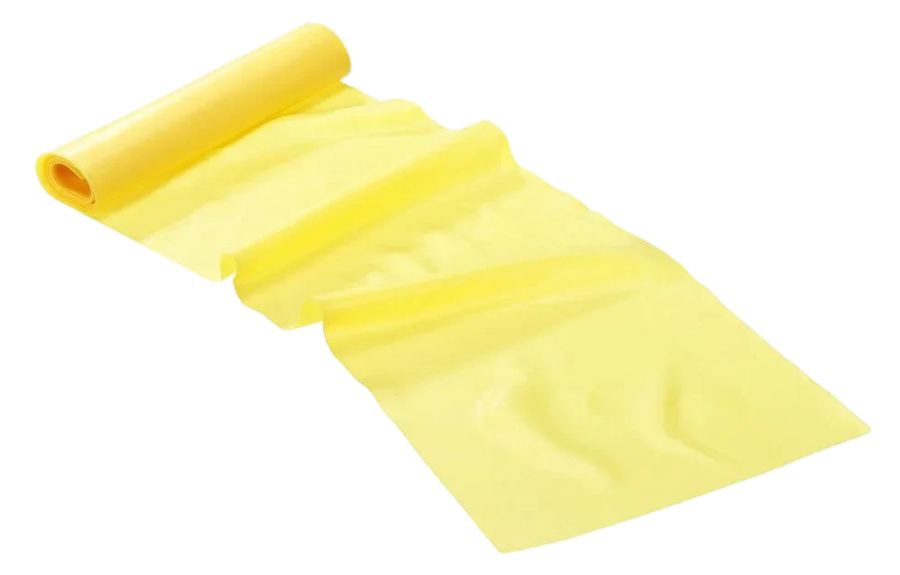
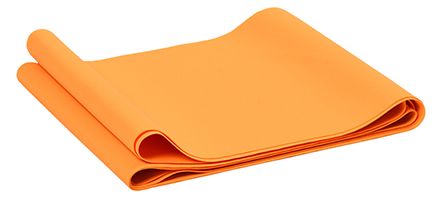
Resistance band: which strength and colour suit you?
Which resistance band strength suits your exercise? Compare Sanctband colours and pull force values, find the right band type and learn five basic exercises along with the safety rules.
Published on
·11 min read
Image: saneq
The strength of your resistance band depends on the exercise, your muscle strength and the band type. Here you’ll find Sanctband colours with pull force values, guidance on choosing a level and five basic exercises. This helps you compare flat bands, loop bands and tubing for your needs.
Guide by the saneq editorial team, based on Sanctband’s pull force chart, safety instructions and exercise manual, as well as manufacturer information from Trendy Sport; bands from our range; no measurements taken by us.
Why doesn’t a resistance band’s colour always indicate the same strength?
One blue band is not automatically as strong as another blue band. For the Sanctband Fitnessband, blue means “Strong”. Thera-Band uses its own colour sequence: beige, yellow, red, green, blue, black, silver and gold. We do not stock Thera-Band. Colours cannot be treated as equivalent resistance levels across these brands.
Band type matters even within a brand. A flat band, a closed loop band and round tubing each have their own resistance values. When comparing, check the product name, level and manufacturer’s chart. The label “Medium” alone does not tell you how much pull force your resistance band produces.
The following table matches the manufacturer’s colours to the six shop levels for the Sanctband Fitnessband, from “Extra light” to “Super strong”.
Sanctband: how much pull force does each colour provide?
These values apply exclusively to the Sanctband Fitnessband as a flat band: at 100 to 300 % elongation, from the manufacturer’s chart, converted into kg by us. The conversion is based on 1 lbf = 0.454 kg; we rounded to 0.1 kg. The ranges show the increasing pull as elongation increases.
Colour
Level in the shop
Pull force in kg at 100 to 300 % elongation
Typical use as a guide
Peach
Extra light
1.3 to 2.6
Mobilisation; rehabilitation under a therapist’s guidance
Orange
Light
2.1 to 3.7
Returning to exercise; rehabilitation under a therapist’s guidance
Lime green
Medium
2.6 to 4.9
Starting fitness training, shoulders and arms
Blue
Strong
3.2 to 5.7
Legs, glutes and core
Purple
Extra strong
4.3 to 8.6
Advanced training
Grey
Super strong
5.1 to 10.3
Advanced training with high resistance
When training, follow the manufacturer’s safety limit: do not exceed 200 % elongation. The suggested uses are our guidance, not the manufacturer’s recommendations. We do not apply any kg values from this flat band chart to Loop, Super-Loop or tubing.
The Sanctband colour sequence for flat bands from extra light to super strong. Numbers 1 to 6 refer to the following key.
Image: saneq
1: Peach, extra light.
2: Orange, light.
3: Lime green, medium.
4: Blue, strong.
5: Purple, extra strong.
6: Grey, super strong.
Which strength suits your training goal?
Start with the movement you want to perform. The following levels are starting points for your choice. What matters is whether the resistance suits your fitness and muscle strength. A resistance band therefore does not need to have the same strength for every exercise.
Rehabilitation and returning to exercise: Extra light or light can be suitable starting points. In rehabilitation, your therapist works with you to choose the band, movement and load.
Mobilisation and older people: Extra light or light provide a guide. Age alone does not determine the level; your existing muscle strength matters.
Starting fitness training, shoulders and arms: Medium may suit you if you can perform the movement with control. If the resistance is too high, choose a lighter level.
Legs, glutes and core: Strong is one possible choice. Check it for each exercise instead of simply reusing the level from an arm exercise.
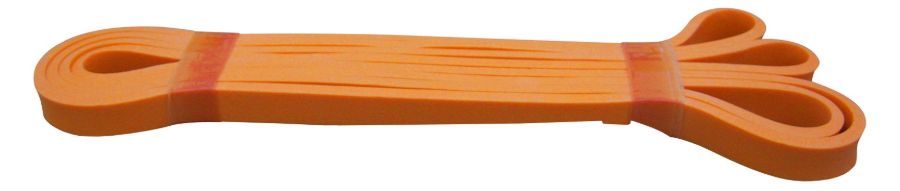
Advanced users: Depending on the band range, extra strong to super strong levels may be suitable. For assisted pull-ups, Super-Loop or Rubber Band are the appropriate types from this selection.
Two to three levels can be useful if you train different parts of your body. Your grip provides fine adjustment: gripping a shorter length of band or doubling it increases resistance. A longer starting length reduces it for the same movement. Keep the elongation limit in mind. A band held shorter reaches it sooner.
Flat band, loop band, tubing or Rubber Band: which type suits you?
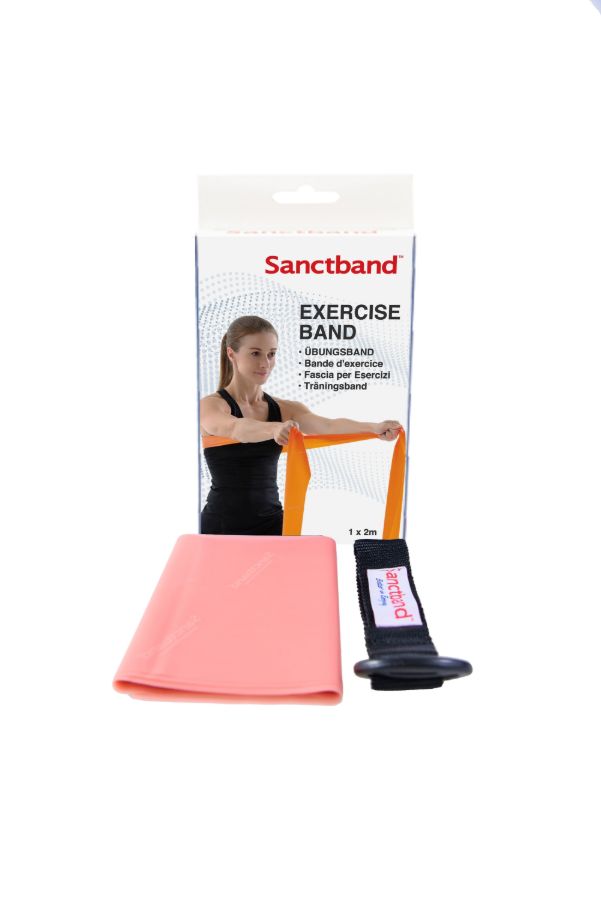
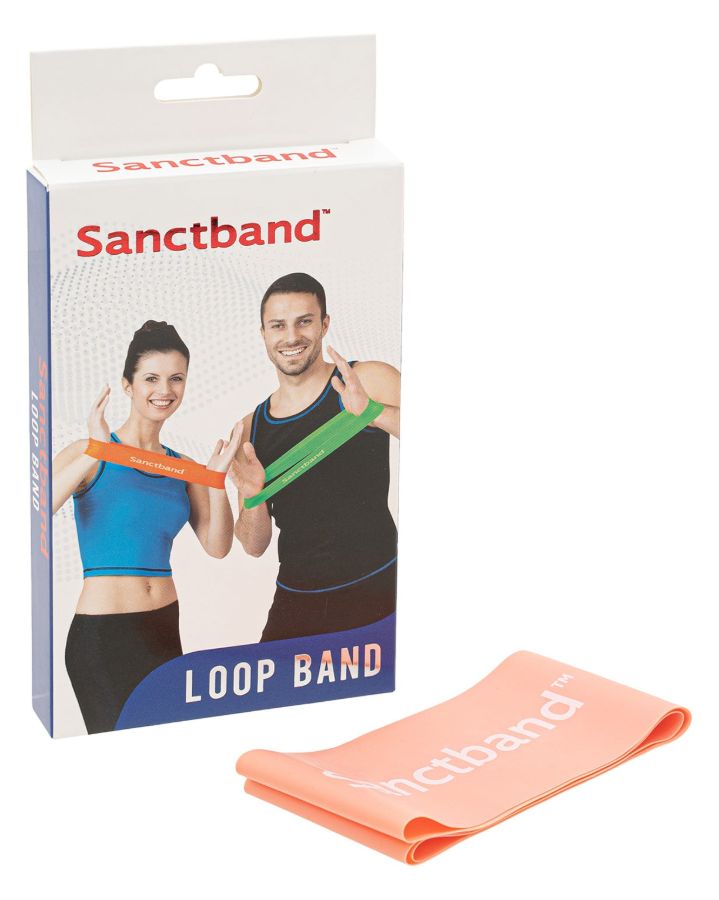
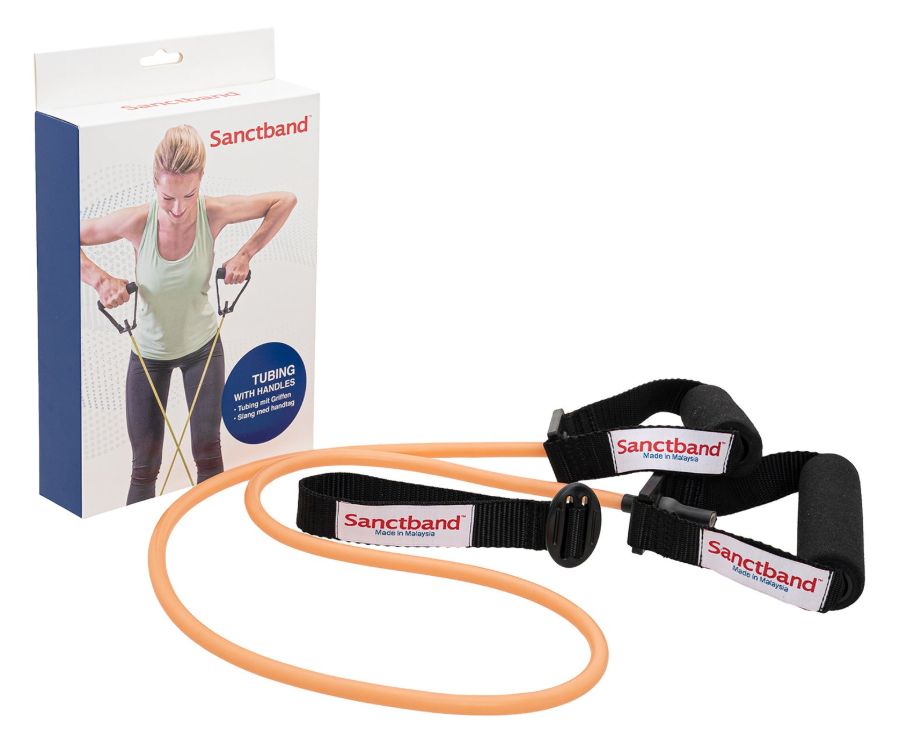
The type determines how you hold or position the band. A flat band has free ends, a loop band is closed, and tubing is a round tube. Choose the type for your exercise first, then the strength. The table sets out the products and their sizes.
For the Sanctband Loop, the sequence is peach, orange, lime green, blue. The Super-Loop follows orange, red, blue, purple. Exercise Tubing has the six colour levels of the resistance band. These sequences show the progression within each range; the pull force chart above remains limited to the flat band.
As a price guide, as of November 2026, including VAT in CHF: the Sanctband Fitnessband 2 m training set costs 13.60, and the 5.5 m roll costs 17.90 to 34.90. The tubing set with handles and door anchor costs 13.80 to 17.50. A Trendy Tone-Loop costs 2.10 to 4.00, a Trendy Rubber Band 10.40 to 29.40. When comparing prices, always check what is included and which version you are comparing.
When is a latex-free resistance band the right choice?
Natural latex can cause allergic reactions. Sanctband reduces the latex protein content through its manufacturing process. The resistance band is still a natural latex product. If you have a latex allergy, choose a model explicitly labelled latex-free. Reduced latex protein content does not mean latex-free.
The Trendy Limite Medical Band is latex-free and powder-free and offers levels 1 to 7. If you want a closed shape, the Trendy Tone Loop Medical is also latex-free and powder-free. For its levels 1 to 5, the manufacturer’s information in our product description specifies 2.7 to 11.9 kg at 100 % elongation. This information applies only to this Medical model.
The fabric Trendy Hip Loop has a nylon weave with a non-slip inner surface; according to the product information, it also contains latex and silicone. “Fabric” alone does not confirm that a product is completely latex-free. What matters is the explicit material information for the band you choose.
How do you perform five basic exercises with a resistance band?
Sanctband’s starter programme includes eight exercises. Here we use five of these movements; we describe side leg raises and standing hip flexion as loop band variations. Before you start, read the safety advice immediately after the exercises and the manufacturer’s instructions. For rehabilitation, have your therapist adapt the choice and execution of the exercises.
Shoulder shrugs with a flat band: Stand on the middle of the band and hold the ends at your sides with your arms hanging down. Raise your shoulders and lower them again with control. Keep your arms straight. 5 to 6 repetitions, 2 to 3 sets according to the manufacturer’s programme.
Side arm raises with a flat band: Secure the band under your foot and hold one end at your side. Raise your arm out to the side and bring it back. Adjust your grip to suit the movement. 5 to 6 repetitions, 2 to 3 sets according to the manufacturer’s programme.
Biceps curls with a flat band: Stand on the middle of the band and hold the ends in your hands. Bend your elbows, raise your hands and lower them with control. Keep your upper arms close to your body. 5 to 6 repetitions, 2 to 3 sets according to the manufacturer’s programme.
Side leg raises with a loop band: Place the loop band around your ankles and stand securely. Move one leg out to the side and back again. This loop band variation adapts the side leg raise. The manufacturer’s flat band programme specifies 5 to 6 repetitions, 2 to 3 sets for this exercise.
Standing hip flexion with a loop band: Place the loop band around both ankles and stand securely. Support yourself with one hand on a wall or chair back. Raise one knee forwards and upwards with control, then put your foot back down. Then switch sides. 5 to 6 repetitions, 2 to 3 sets according to the manufacturer’s programme.
How do you use and care for your resistance band safely?
For mobilisation and returning to exercise, extra light or light provide a guide. Medium may suit you when starting fitness training. The exercise and your muscle strength are what matter. For rehabilitation, discuss your choice with your therapist.
Identify the brand and band range first. Only then will the matching colour chart help you. If you only know the colour, you cannot reliably determine the strength. Compare the available product information or ask us.
Yes, this increases the resistance. The manufacturer does not give an exact kg value for this. Check whether the load still suits your exercise, and continue to observe the elongation limit and safe band positioning.
Sanctband specifies 5 years from the date of manufacture for unopened, unused products. This is not a general lifespan for a used band. Check it before every use and replace it if you find holes, tears or cuts.
That depends on the exercise. A loop band already forms a closed loop, for example for side leg raises. With a flat band, you can grip the free ends and adjust the starting length. Choose according to the band positioning you need.
No. Both brands have their own colour systems. The band type must also match for a meaningful comparison of resistance. Use the manufacturer’s chart for the specific product. The Sanctband pull force chart in this article applies only to the flat band.
Still unsure? We can advise you on the right band type and strength. You can also contact our Showroom in Spreitenbach. You’ll find the selection in the Resistance bands category. If you plan to use the band for rehabilitation, also discuss your choice with your therapist.