Standard, lightweight, multifunction, transport or bathroom: What distinguishes the types, who they suit and what they cost.
Published on
·14 min read
Image: saneq
Which wheelchair suits you depends primarily on your daily life: Do you propel yourself, are you pushed, or do you need support while sitting? This guide explains the differences between wheelchair types and shows which questions narrow down your choice. Specific models make weight, features, and costs comparable.
A guide by the saneq editorial team based on manufacturer documents and the WHO wheelchair provision guidelines. The model examples come from our range, as of September 2026. We have not conducted our own practical test. The selection aid does not replace personal assessment and adjustment.
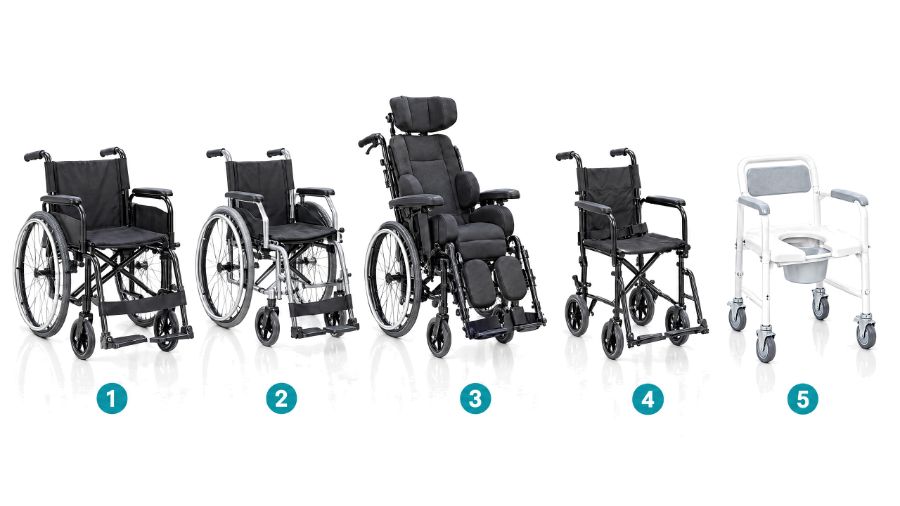
The graphic above shows five wheelchair types from left to right. The numbers help with assignment; they do not represent a ranking.
No.
Type
Typical for
1
Standard wheelchair
Everyday life, temporary need, self-propulsion or being pushed
2
Lightweight wheelchair
Frequent loading, self-propulsion
3
Multifunction wheelchair
Care, adjustable seating position
4
Transport wheelchair
Short accompanied routes, also when travelling
5
Shower-toilet wheelchair
Shower and toilet
What types of wheelchairs are there?
Wheelchairs can be distinguished by drive, construction, and use. A manual wheelchair is propelled by muscle power: by yourself or by a companion. An electric wheelchair has a motorised drive. "Folding wheelchair" describes the construction. A foldable model can also be a standard, lightweight, or transport wheelchair.
This focuses on manual models from the saneq range. Active or adaptive wheelchairs are particularly tailored to independent mobility and the person. They, as well as electric and standing wheelchairs, are not part of this model selection. If you want to propel yourself daily, a specialist should also check such provision options with you.
Standard wheelchair: basic equipment for everyday use
A standard wheelchair supports everyday routes at home and in care facilities. It is also suitable for temporarily limited walking ability, for example after surgery or an accident. Large rear wheels with handrims enable self-propulsion if suitably fitted. The handrims are the rings on the outside of the wheels. A companion can take over via the push handles.
The Ecotec 2G is frequently chosen at saneq. It has a steel frame, swing-away armrests, and removable drive wheels. According to the manufacturer, it is loadable up to 130 kg. Without drum brake, it is 30 cm wide when folded. At saneq, it costs from CHF 299 including VAT, as of September 2026. Its instructions specify flat, firm surfaces. The Rotec offers, among other things, an adjustable back height.
Lightweight wheelchair: check weight and features together
Lightweight wheelchairs are particularly interesting if you frequently load the chair. The models presented here have aluminium frames. The Litec 2G weighs from 13.6 kg, the standard wheelchair Ecotec 2G from 18.6 kg. These manufacturer specifications apply to 38 cm seat width without drum brake. The difference is 5 kg total weight. The actual lifting weight depends on which parts you remove before loading.
According to the manufacturer, the Litec 2G Plus includes seat cushions, cane holders, and anti-tip devices among its features. It weighs more than the basic model. The Freetec offers an adjustable back cover and adjustable seat depth. Compare such functions with your requirements for seating position and operation.
Multifunction wheelchair: targeted positioning of seat and backrest
A multifunction wheelchair offers additional adjustments for the seating position. With the Multitec, the seat unit and backrest can be angled. When tilting the seat unit, the seat tilts with it; a backrest adjustment changes the angle between seat and backrest. There is also a headrest and flip-up leg rests. The combination can be useful for a correspondingly clarified need.
This type is suitable if you need targeted support and change of seating position. Clarify with a specialist which adjustments help and who operates them. A multifunction model can also have handrims. Test on the specific model whether you can manage your daily routes independently with it.
Transport wheelchair: short routes with accompaniment
A transport wheelchair with small rear wheels and without handrims is moved by a companion. According to the manufacturer, the Travelite weighs a total of 9.3 kg and comes with a carrying bag. Its instructions limit use to short accompanied routes on flat, firm surfaces.
The Expedition Plus is another option for accompanied routes. According to the manufacturer, it has a dual-function brake for slowing and locking. Clarify before choosing who pushes and whether this person can control the chair on the intended routes. More models can be found under transport chairs.
Shower-toilet wheelchair: for personal care and toilet
A shower-toilet wheelchair is designed for tasks in the bathroom. The Aston includes a hygiene cut-out, a toilet bucket, and flip-up armrests. Its instructions limit use to indoor areas. The shower must be accessible with the chair. Also check whether the specific version fits your toilet.
The DuoMotion offers a washable adjustable back. Aston and DuoMotion have different wheel versions. Choose according to ease of use and the space needed in the bathroom.
The TRS 130 is a toilet aid with bucket and swing-away armrests. Its intended purpose is not approval for showering. Follow the instructions, not just the similar appearance. The corresponding areas in the shop are shower aids and toilet aids.
Self-propulsion or being pushed: what decides?
Self-propulsion or being pushed: two ways of mobility.
Image: saneq
A shows self-propulsion via handrims. B shows a transport chair with small rear wheels pushed by a companion.
For self-propulsion via handrims, you must be able to reach, grip, and control them. This also includes steering and stopping. Test these activities with the appropriately adjusted model. A wheelchair with handrims can also be pushed. A small transport chair without handrims does not offer this choice.
Wheel size alone is not sufficient for classification. According to manufacturer data, the D-Lite is offered with 12.5- or 24-inch wheels. Its instructions for use describe short use by an assistant or caregiver. Do not infer approval for self-propulsion from the large wheels. For this use, the suitability of the specific version must be clarified.
If a companion frequently pushes, reachable push handles and a suitable companion brake are important. A drum brake is operated via levers on the handles and serves for controlled slowing. The parking brake secures the stationary wheelchair. Have both functions explained to you. Observe the surfaces and slopes approved in the instructions. In the models shown here, the drum brake makes the wheelchair wider and heavier. The values can be found in the guide "Measuring your wheelchair correctly".
Which wheelchair type suits your everyday life?
The table helps narrow down. It does not replace individual advice. The starting point is the task the wheelchair is to fulfil.
Your situation
What you should check
Decisive point
Temporary need, e.g. after surgery
Standard or lightweight wheelchair; transport chair also for exclusively short accompanied routes
Sitting, propulsion and transferring must fit the current situation.
Check approval for the respective use and bathroom accessibility.
What should you pay attention to when choosing?
Nine components of a manual wheelchair. The numbers correspond to the following legend.
Image: saneq
Push handle with drum brake lever: Check whether the companion can easily reach the handle and brake lever.
Backrest: Have it checked whether height and support suit your sitting posture.
Armrest: Check whether height and swivel function facilitate transferring and access to the table.
Parking brake: Check when stationary whether both parking brakes secure the wheelchair against rolling away.
Handrims: Test whether you can reach the rings and control driving, steering and stopping with them.
Drive wheel with quick-release axle: Have the removal and secure locking of the wheel demonstrated.
Steering wheel: Check whether the front wheels turn freely and are undamaged.
Footrest with footplate: Have it checked whether your feet are supported and the footplates fold up for transferring.
Anti-tip device: Have the anti-tip device adjusted according to the instructions and its operation demonstrated.
Describe everyday life and seating needs first
Note your typical routes and activities. Do you use the chair at home, shopping, or only for appointments? Do you want to move independently to a table? Who helps when strength fades? Include the person who will later push or assist with transfers.
Seating provision is also part of the selection. Discuss longer sitting times, pain and existing pressure sores with a medical or therapeutic specialist. Your abilities, seating needs and daily tasks are decisive.
Consider transferring and operation
Swivel armrests and removable leg rests can facilitate access when transferring. Check whether you can reach and operate locks. Have it shown what support you need.
Compare load capacity, weight and wheels
Load capacity: Observe the manufacturer's limit for the chosen version. Clarify which accessories and carried items must be considered in the permissible load.
Weight when loading: Compare the weight in the intended transport condition. Have it shown which wheels and leg rests you can remove for this purpose.
Tires: Solid rubber or PU tyres require no air pressure control. Nevertheless, check for wear and damage. Check on the specific model whether the wheels move well on your routes.
Brake equipment: Among the standard, lightweight and multifunction models in the table, there are versions with drum brakes. Choose these according to the needs of the companion.
Check seat width, overall width and space requirements on the specific version. The measuring steps for body, doors and car can be found in the guide "Measuring your wheelchair correctly".
Test features and clarify service
Compare what is included: such as seat cushions, anti-tip devices or cane holders. Clarify special pressure relief with a specialist; the suitability of the seat cushion must be individually assessed. Have changes to the seating position and adjustment of the anti-tip device professionally carried out.
Provision includes assessment, adjustment, instruction and follow-up according to WHO guidelines. Try out important everyday activities with professional support. Also clarify maintenance, repairs and available spare parts in advance. Noticeable brake behaviour or damaged parts should be handled by the specialist retailer.
What does a wheelchair cost?
In our range, prices for toilet wheelchairs start at CHF 168 and for transport chairs at CHF 205. Standard wheelchairs cost from CHF 299, lightweight wheelchairs from CHF 429. Shower-toilet wheelchairs are available from CHF 529, multifunction wheelchairs from CHF 1399. All entry prices include VAT, as of September 2026.
The table shows specific models from drive. The price ranges result from the versions. Weights and load capacities are manufacturer data from the product information. The weights refer to the specified total weight; accessories and the actually ordered version must be additionally checked.
The ranges within a model result from the recorded versions. For Aston and DuoMotion, the separate weights refer to the variants with small or large wheels. The lowest price and the lowest weight do not necessarily belong to the same configuration. Therefore, compare the offer for exactly the required variant.
For wheelchairs, the MiGeL from 1 July 2026 does not provide reimbursement through basic insurance. Clarify possible benefits from IV or AHV before purchase with the responsible authority; an overview is provided in the financing section on our wheelchairs page.
Which models can you compare more closely?
The following selection picks up the differences described above: Ecotec 2G for basic equipment, Litec 2G for weight, and Litec 2G Plus for additional features. Multitec stands for positioning. Travelite and Expedition Plus show options for short accompanied routes. Aston and TRS 130 separate the need for shower and toilet from pure toilet use.
The additional wheelchair comparison includes the models in the wheelchair category. Transport chairs and shower/toilet aids can be checked on the respective product pages.
Which questions about wheelchair types are frequently asked?
Our lightweight wheelchairs have aluminium frames, the standard wheelchair Ecotec 2G has a steel frame. A concrete comparison: Litec 2G 13.6 kg, Ecotec 2G 18.6 kg. That is a 5 kg difference in total weight according to the manufacturer, each with 38 cm seat width without drum brake. Always compare the desired version and equipment.
Foldable refers to the construction. Standard, lightweight, and transport wheelchairs can also be foldable. Drive and seating system should be checked additionally on the specific model.
It can be suitable for short accompanied routes if its intended purpose allows. A model without handrims does not allow self-propulsion over them. For longer sitting times and independent mobility, a separate assessment is needed.
A model with additional positioning options, such as a tiltable seat unit and adjustable backrest. The choice depends on the support you need while sitting. Which functions are suitable should be clarified with a specialist.
No. The decisive factor is whether and on which routes a companion pushes. Have their needs and the brake operation checked on the specific model. The parking brake remains important for securing when stationary and transferring.
The diagnosis alone does not answer this question. Mobility, balance, grip function, seating needs, and support in daily life differ. Coordinate the provision with a medical or therapeutic specialist and the specialist retailer.
Still unsure? Describe your typical routes to our team, whether you want to propel yourself and what support is available. This way, we can narrow down the models and features with you. Personal seating provision and instruction should be coordinated with a suitable specialist.