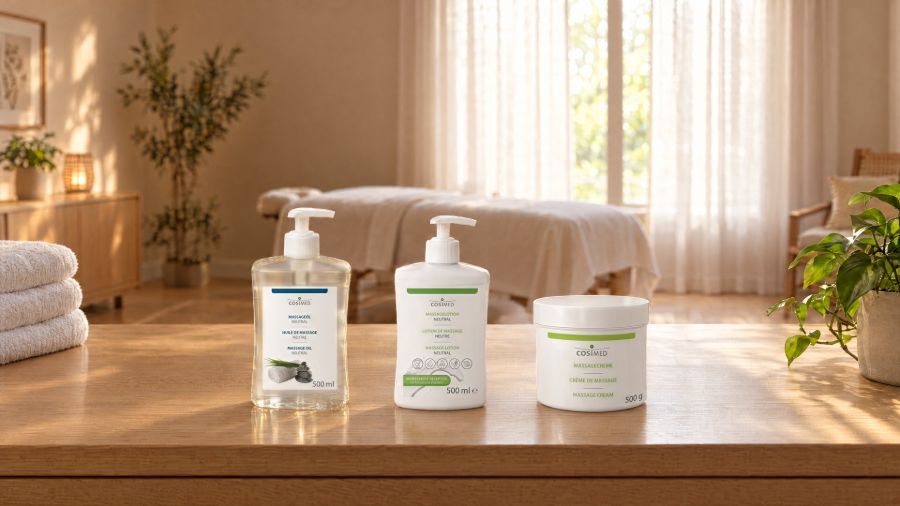
Massage oil, lotion or cream: what suits your practice?
Looking for lasting glide or more grip? Compare oil, lotion and cream for everyday practice – with guidance on labelling, dispensing, shelf life and laundry, plus cost examples from our range.
Published on
·14 min read
Image: saneq
Do you need lasting glide or more grip for targeted techniques? Compare massage oil, lotion and cream for physiotherapy and massage practice – by technique, formulation and quantity. You will also find guidance on dispensing, shelf life and laundry, as well as material costs.
The saneq editorial team uses information from manufacturers and training providers, as well as sources from the Office for Consumer Protection and Veterinary Affairs in St. Gallen (AVSV), the Federal Food Safety and Veterinary Office (FSVO), the Industry Association for Personal Care and Detergents (IKW) and aha! Allergy Centre Switzerland. Fire safety information comes from the Fire Prevention Advisory Centre (BFB), the Institute for Loss Prevention and Damage Research (IFS) and the accident insurance institution for the food and hospitality sectors (BGN). The examples come from our range; the cost calculation is our own. We did not conduct our own practical test.
Massage oil, lotion or cream: how do they differ in use?
Grip describes how securely your hand holds the skin while working. Oils are usually chosen for long, flowing strokes, and lotions or creams for more targeted contact. Formulation and quantity can be more important than the product name.
This gel is described for long-lasting glide; the manufacturer mentions slow absorption without stickiness.
Apply thinly and add if necessary. According to product information, non-greasy and easily washable.
Long, gliding applications on larger areas.
Schematic texture comparison: 1 = oil forming a glossy film; 2 = lotion spread in a more matte layer; 3 = opaque cream with a defined outline. No measurement of glide duration or consumption. The actual texture depends on the formulation.
Image: saneq
Start with your workflow: do you need lasting glide, controlled grip or a less oily feel on the skin before dressing? Assess the chosen product using a small amount.
Read the "Ingredients" list on the current container: the INCI names identify the ingredients. The table shows selected information for specific variants, as of 30.09.2026. Check the full ingredient declaration on the container.
Cocos nucifera oil, i.e. coconut oil; no other ingredient according to product information.
One ingredient, no added perfume. Follow the guidance on laundry and shelf life.
The amba skin care and massage oil range includes variants with fragrant essential oils. The cosiMed massage gel contains camphor, menthol and alcohol, among other ingredients; arnica and chamomile extracts are listed for the fascia wax. These ingredients do not establish suitability for treating symptoms.
How do you get oil, lotion and cream from storage to the treatment table?
Plan your stock, working container and dispensing method together:
Select the right dispensing aid. Choose the cosiMed dosing pump to match the product and container. The versions for oval bottles, cream jars and canisters differ.
Prepare the working container. Transfer product only into a cleaned container suitable for this purpose. The cosiMed dispensing bottle is intended for decanting from a canister and has a flip-top cap.
Close the stock container and maintain traceability. Close the stock container after decanting. Clearly record the product, batch and original opening date on the working container. Decanting does not start a new shelf-life period.
Dispense hygienically. Use the appropriate pump or, for a jar, a clean spatula. Do not return any product you have removed to the stock container.
Start sparingly. Add only if grip and glide require it. The amount per pump stroke depends on the version – measure it for your calculation.
Check how to prepare for reuse. Clean dispensing aids according to the manufacturer’s instructions and store containers as specified. If the reprocessing procedure is unclear, ask the manufacturer.
How do you read shelf life and opening information on your container?
The AVSV information sheet distinguishes between two cases: for a shelf life of less than 30 months, the container carries a best-before date. For more than 30 months, this is not mandatory; the period of use after opening is then generally indicated.
The open jar symbol indicates this period; "M" stands for months. Observe the date, storage and warning instructions on your container and note the opening date. If information is missing or unclear, ask the manufacturer.
Do not leave containers open. Store them according to the product instructions, protected from intense heat and direct sunlight. According to IKW, a change in colour, an unusual smell or an altered consistency are reasons to stop using a product. A normal appearance does not extend the stated period of use.
How do you deal with oil residues in towels and covers?
BFB warns against putting oil- and fat-soaked cloths in the tumble dryer. IFS explains the connection with massage for vegetable oils containing unsaturated fatty acids. Treat all textiles containing oil with the same caution in your practice routine – even when products are described as "non-greasy".
Handle practice laundry separately. Following BGN guidance, wash laundry heavily soiled with grease separately, using a suitable detergent. Also follow the instructions for both the textiles and the detergent.
Check the washing results. Do not overload the machine. Review the washing procedure if oil or fat residues remain.
Avoid heat build-up. Let warm textiles cool completely before stacking or putting them away (BFB, BGN). A rancid or burning smell is a warning sign. Inform everyone who handles the laundry.
Treat cleaning cloths separately for disposal. The BFB recommends soaking oil- or fat-soaked cloths completely in water and drying them outdoors before disposal. For reusable towels, the washing and cooling rules above apply.
How much does massage oil or lotion cost per treatment? A calculation example
Calculation example, prices as of 30.09.2026. The table uses saneq’s regular prices without temporary promotions, in CHF including 8.1 % VAT, each for one container. For a hypothetical treatment, we calculate with 10 ml or 20 ml. Both quantities are solely calculation assumptions, not dosage recommendations.
Material cost = container price × assumed quantity in ml ÷ container contents in ml. Costs are rounded to Swiss centimes only at the end. The price per litre allows comparison between containers.
For the neutral 1-l massage oil, CHF 19.10 × 10 ÷ 1000 gives approximately CHF 0.19. For your practice, calculate using your recorded consumption and actual purchase price.
Oil, lotion and cream can require different quantities for the same procedure. Separate accessories, laundry, working time, leftover amounts and shipping are not included.
For 5- and 10-l canisters, plan for storage space, handling and decanting. Consider consumption and the period of use. Current variants and prices are on the linked product pages.
The product cards link to the products and their different variants. Statements about Neutral do not automatically apply to all scented variants.
What questions about massage oil, lotion and cream frequently arise?
Check the stated intended use and how the specific lotion behaves during use. A body lotion is not automatically interchangeable with a massage lotion. How long it glides and when you need to add more depend on its formulation; there is no single duration that applies to every product.
"Neutral" is a variant name here, not reliable proof that a product is fragrance-free. The product information for cosiMed Neutral massage cream and Piniol Neutral massage oil lists perfume. If you want to avoid fragrances, read the current ingredient declaration rather than relying only on the name.
Discuss the intended use with your dermatologist. Massage products are cosmetics, not a treatment for atopic dermatitis; even unscented products require an individual assessment when the skin is affected by a condition.
Avoid it as a precaution and have a medical professional assess its suitability for the individual. The ingredient declaration lists almond oil; "refined" is not proof that it is free from allergy risks. The aha! warning about peanut oil describes possible sensitisation when the skin barrier is impaired. The warning applies to peanut oil; this source makes no statement about almond oil.
A fixed amount does not fit every application. The training provider wellnessheimstudium gives a rough guideline of one to two teaspoons for a larger body area. Start sparingly and add according to grip and glide. The 10 ml and 20 ml in our cost table are independent calculation assumptions.
According to the product information, cosiMed coconut fat is used as a base oil for massage. It contains only coconut oil, has a subtle scent and melts at about 22 °C according to the description; a portion taken from the container becomes liquid in a warm hand. Follow the labelling, storage instructions and guidance on textiles containing oil.
Choose the pump to match the product and container: cosiMed has versions for oval bottles, cream jars and canisters. A pump for the 1-l cream jar does not automatically fit the 500-ml jar shown.
Still unsure? saneq can help with questions about variants, containers and suitable dispensing aids. Small containers can help you get to know how a product behaves during use. For known allergies, skin conditions or symptoms, a medical professional is the right person to consult.
The kinesiology tape guide complements your practice routine with tips on skin preparation, application and removal.
For cupping massage, choose an oil suitable for the cup that balances adhesion and glide. The cupping guide explains how to use and care for cups, and their limitations.