How to use cups correctly: dry cupping and cupping massage
How do you apply cups, adjust the suction and remove them? This guide explains dry cupping and cupping massage, with manufacturer guidance on duration, skin reactions and cleaning.
Published on
·22 min read
Image: saneq
How do you apply cups, adjust the suction and take them off again? This guide takes you through dry cupping and cupping massage, skin checks and cleaning. For self-use, you need a product intended for that purpose and practical instruction from a qualified professional; unexplained symptoms must be assessed by a doctor first.
This guide by the saneq editorial team is based on the BellaBambi instructions for use and the AcuTop application description. The instructions from methatec, pulox, Assistent, Hwato and Meridius serve as comparison sources for handling, safety and care; further guidance comes from NCCIH and PHYSIOZENTRUM. The products come from our range; we did not carry out our own practical test. The diagrams are our own illustrations. The organisations mentioned have not reviewed or authorised this guide.
What is dry cupping, and what is this guide based on?
In dry cupping, a cup creates negative pressure on intact skin and stays in one place. In cupping massage, it glides over oiled skin. 'Dry' means without breaking the skin, not necessarily without oil. The vessels are also called cupping glasses, cupping jars or simply cups.
Fire cupping carries a risk of burns and belongs in professional hands. Wet cupping is also reserved for qualified professionals because of the risks of bleeding and infection, and is not taught here.
The evidence on pain relief is uncertain. NCCIH considers most of the research to be of poor quality. The review by Jenkins et al. (JOSPT Open, 2026) compared dry cupping with sham cupping: across five randomised trials with 281 participants, the effect on pain remained very uncertain at every time point studied.
Jia et al. (BMJ Open, 2025) found indications of an immediate reduction in pain, but no statistically established overall benefit for physical function or mental health. This review combined different cupping methods and control groups. Its results therefore cannot be equated with those of a comparison solely against sham cupping. They do not establish a reliable benefit for your symptoms. Cupping does not replace medical assessment or treatment.
How do bulbs, valves, pumps and silicone cups differ in use?
The design explains how suction is created. Whether a product is intended for self-use is stated in its instructions for use. This overview follows the respective manufacturer information cited; care and operating instructions cannot simply be transferred between products.
Squeezing expels air; releasing creates negative pressure. AcuTop describes this sequence: place the cup, squeeze the bulb, release the bulb. The order of application and the removal method depend on the model.
AcuTop describes its acrylic cup body as more resistant to breakage than ordinary glass. Check the cup body and rim for damage before every use. The cup body and bulb may need different care; follow the instructions in the packaging. The design alone does not authorise self-use.
The valve allows negative pressure to be created again without removing the cup.
Model for professional practice: the manufacturer specifies use by qualified professionals. This does not provide instructions for self-use.
Set with a hand pump
The pump connects to the cup's valve. Depending on the model, pressure is equalised by lifting a pin or pressing a valve.
Hwato and Meridius describe different release mechanisms in the instructions for their pump sets. Check your set's release mechanism before applying a cup. These comparison instructions are not AcuTop instructions.
Silicone cup
Squeeze the cup, place it on the skin and release slowly. With BellaBambi, squeezing less produces less suction.
BellaBambi describes self-use. This authorisation and its care instructions do not automatically apply to every silicone product.
The following checklist brings together guidance from pulox, Assistent, BellaBambi and the specialist sources linked below. Some manufacturers prohibit use, while others require medical consultation. For this introductory guide, we set stricter limits and do not provide instructions for self-use in these cases:
Bleeding risk: clotting disorders, an increased tendency to bleed, a pronounced tendency to bruise or blood-thinning medication. Do not stop medication for this purpose or change it yourself.
Skin and injuries: areas that are open, injured, swollen, contused, producing pus or already bruised; inflammation, allergic skin changes, sunburn, eczema/atopic dermatitis, psoriasis, hives and other acute or chronic skin conditions.
Veins and other conditions: varicose veins, inflamed veins, ulcers caused by diabetes or vascular disease, and Sudeck's disease/CRPS.
Heart, circulation, kidneys and bones: severe heart disease, heart failure, cardiac arrhythmias, a pacemaker, kidney impairment, anaemia, critically high blood pressure and an acute bone fracture.
Tumours and impaired immunity: tumour diseases, a history of radiotherapy or irradiated skin, generalised oedema, impaired immunity, and long-term cortisone treatment or skin altered by it.
Acute or unexplained symptoms: also illnesses with fever and recent muscle or fascia injuries. Do not use cupping after drinking alcohol or when severely exhausted. The instructions from another pump-set manufacturer (Hwato) also list menstruation and active pulmonary tuberculosis among the exclusions; observe such product prohibitions and discuss any questions with a doctor.
Pregnancy: pulox prohibits use; BellaBambi requires medical consultation. This does not amount to general authorisation from any particular month of pregnancy.
This guide excludes cupping on the following areas:
On the spine, on vertebral or other bony prominences, and over the edges of the shoulder blades.
Over the heart, on major blood vessels, varicose veins or inflamed veins.
On the eyes and eyelids, ears, nose, lips, inside the mouth and on the nipples.
On the genitals and anus, over lymph nodes or in the area of lymphatic vessels, the armpits and groin.
Over scars, moles, warts, existing bruises, and injured or diseased skin.
On the head, face and neck, and on the front and inner surfaces of the body. These are the stricter limits used in this guide; some manufacturers describe other applications.
Have a qualified professional demonstrate the body area, suction and pressure release for your model. Use only a model intended for self-use. The following procedure explains the principle; the enclosed instructions remain authoritative.
Check the instructions and release mechanism. Read who may use your product, its contraindications and its operating instructions. Before applying a cup, establish how to release the negative pressure. A requirement for use by qualified professionals still applies after you have received practical instruction.
Prepare the equipment. Check the glass or cup body, rim and accessories for cracks, chips, sharp edges and wear. Do not use damaged parts. Clean and disinfect according to the product instructions, including before first use if the instructions require it.
Check the skin and contact area. Choose a clean muscular area with intact skin that you can observe easily. The rim must make contact all the way round. If body hair prevents a seal, methatec mentions a little oil to help seal the rim; only do this if it is also specified for your model. Keep oil off the suction bulb.
Create negative pressure. With the AcuTop bulb model: place the entire rim on the skin, gently squeeze the bulb and release it. For its silicone cup, BellaBambi describes squeezing first, then placing the cup and releasing slowly. With a pump set intended for self-use, connect the pump according to the set's instructions and create only light suction. No fixed number of pump strokes is specified here.
Check the suction. The skin should rise only slightly. You may feel a gentle pulling sensation; release the cup immediately if the pulling is painful or you feel any other discomfort. Do not increase suction to hold a poorly seated cup in place.
Watch the skin. Start with a few minutes, with no minimum duration. Release the cup no later than when you notice marked, dark or bluish discolouration, burning, numbness, blisters, bleeding, dizziness or nausea. pulox requires removal as soon as red or blue discolouration begins. Always observe any earlier limit in your instructions; in this guide, never exceed 15 minutes.
Release in a controlled way. If the instructions for your bulb or silicone model specify release at the rim, gently lift one side of the rim until air enters. Only lift off the cup once the pressure has equalised, and do not pull it off abruptly. With pump sets, use the designated release mechanism: Hwato describes lifting the pin, while Meridius describes pressing the valve. Choose the technique solely according to your set's instructions.
Check the skin afterwards. Stop if you feel unwell and take time to rest. Do not scratch the treated areas. Do not use cupping again over irritated skin or marks; seek medical advice if you develop blisters, broken skin or persistent symptoms.
Reprocess the equipment. Clean and disinfect the parts according to their respective instructions. Let them dry and store them away from dust and moisture. The differences are set out in the cleaning table below.
Application based on AcuTop and methatec: 1 = place the entire rim on the skin and squeeze the bulb. 2 = release, gently drawing up the skin. 3 = lift one side of the rim to let air in; do not squeeze the bulb. Do not pull the cup off abruptly. The diagram shows the principle; follow your model's instructions.
Image: saneq
How long can cups stay on the skin?
Start with a few minutes and watch the skin, as Helsana describes for general guidance. Mild redness may occur; it is not a reason to use cupping for longer or with stronger suction. The sources give different guidance depending on the product and application. There is no guaranteed safe duration and no minimum time.
For this guide: never exceed 15 minutes, and release immediately if any of the warning signs mentioned occur. A shorter time specified for the product takes precedence. pulox requires removal as soon as red or blue discolouration begins; this remains a binding requirement for its product and does not guarantee that no marks will develop.
10–20 minutes; also requires removal as soon as red or blue discolouration begins.
The upper value is not a recommendation in this guide. The skin-reaction rule requires earlier removal.
BellaBambi gives the following approximate values based on experience when the cup stays still in one place. These are possible skin reactions, not target times or scientifically established safe thresholds:
Skin type according to BellaBambi
Pressure mark after approximately
Redness after approximately
Bruising after approximately
Sensitive skin
1–2 minutes
2–3 minutes
5 minutes
Normal skin
2 minutes
4 minutes
7 minutes
Robust skin
3 minutes
6 minutes
9 minutes
Do not wait until the time in the last column. Marks can occur even with light suction. This table is neither a timetable for other brands nor a duration guide for gliding massage.
How does cupping massage on the back work?
Only treat your back with help: have a qualified professional demonstrate the techniques to you and the person helping you. The contraindications and excluded areas above also apply here. Do not treat your back without the skin being visible. The second person must watch the skin and be able to release the cup immediately if you feel discomfort.
Which oil is suitable for cupping massage?
Use a massage oil that is suitable according to the cup's instructions. cosiMed cupping oil is offered for gliding cupping applications. The manufacturer's information for the Harmonie variant lists almond oil, jojoba oil and fragrances among its ingredients. Check the ingredients of your specific variant and do not use it if you have a known intolerance. A specialist oil does not promise a better therapeutic effect.
Take care with oil and heat: keep oil away from the suction bulb. methatec expressly warns that oil and alcohol can damage its PVC bulb; for other models, follow their material-specific instructions. Towels and clothing with oil residues must not go in the tumble dryer: cosiMed warns of spontaneous combustion at high temperatures.
Based on Brands-Gündling at Thieme (2024), this example shows lengthwise strokes over the muscles beside the spine. BellaBambi explicitly excludes the spine. In this example, start below the shoulders; keep the neck, shoulder-blade edges, vertebrae and other bones clear. Release immediately if there is painful pulling, burning, numbness, dark or bluish discolouration, blisters, bleeding, dizziness or nausea. Any requirement for earlier removal in the product instructions takes precedence.
Get into a comfortable position in which the person helping you can clearly see your back and skin. The skin must be intact. Have a thin layer of oil applied to the chosen muscular area without wetting the suction bulb.
The person helping you applies a glass cup or other cup intended for massage beside the spine with light suction. Skin sensation and the cup's fit are checked before movement begins.
The person helping you moves the glass cup or other cup slowly and evenly along the back muscles. With the bulb model, they hold the glass body and leave the bulb unsqueezed while gliding. Keep the spine and bony areas clear. If the cup sticks or pulls uncomfortably, release it instead of dragging it further with force.
Keep the application short. netDoktor describes a few minutes for cupping massage; warning signs mean stopping sooner. The person helping you releases the suction in a controlled way according to the model's instructions and only then lifts off the cup. Have the skin checked and reprocess the equipment.
Cupping massage based on Brands-Gündling (Thieme 2024) and BellaBambi: 1 = oil the skin. 2 = apply with light suction. 3 = move lengthwise beside the spine. Lines show paths, not a mandatory direction. Keep the spine and bones clear. A second person helps with the back.
Image: saneq
The diagram shows both sides without prescribing two cups moved at the same time; our sources do not establish a general direction of strokes towards the heart or lymph nodes. For its silicone cups, BellaBambi describes downward strokes or, when working with a second person, crescent-shaped strokes outwards. We do not use its starting position below the hairline here: our example from the specialist literature stays with lengthwise strokes below the shoulders.
What skin reactions can occur, and when must you stop?
Redness and bruising may occur. PHYSIOZENTRUM and Brands-Gündling describe these fading after a few days, as do the Meridius instructions. No fixed timeframe can be promised: NCCIH also lists persistent discolouration, scars and infections. Marks are not proof of an effect and are not a treatment goal.
Release the suction immediately if you notice any of these signs:
Marked, dark or bluish discolouration; if your product instructions require earlier removal, that requirement applies.
Painful or increasingly strong pulling, burning, numbness or other unusual changes in sensation.
Blistering, broken skin or bleeding.
Dizziness, nausea, circulatory symptoms or otherwise feeling unwell.
Do not scratch the areas or use cupping again over irritated skin or bruises. Have blisters, broken skin, persistent or increasing pain, fever, and pronounced or non-fading skin changes assessed by a doctor. Do not endure symptoms as a supposed 'initial worsening'.
You cannot read a diagnosis from the colour of a mark. The sources used do not establish any association between colours and organs or diseases. Skin characteristics, suction and duration can influence the reaction; a darker mark does not mean the application was more successful.
How do you clean and disinfect glass cups, other cups and suction bulbs?
Clean the equipment after each use and disinfect it according to its specific instructions for use. Remove oil residues. When choosing and using a cleaning or disinfecting agent, observe the approved material compatibility, concentration and contact time. Cleaning, disinfection and sterilisation are different processes; soapy water or boiling does not replace prescribed professional sterilisation.
At home, use a set dedicated to one person. NCCIH warns that equipment can accidentally become contaminated with blood even during dry cupping. Without sterilisation between users, blood-borne pathogens can be passed on. Simply washing the equipment therefore does not make it suitable for sharing. Professional reprocessing belongs in qualified hands.
Product or component
Documented care instructions
Important limit
methatec glass body, professional model
Clean with the bulb removed and disinfect using an agent approved by the manufacturer. The laboratory glass is autoclavable according to the instructions.
This applies to the glass body of this professional model. It cannot be extended to acrylic or the suction bulb; it is not a guide to home sterilisation.
pulox glass cups, comparison product
The instructions specify thorough cleaning and disinfection with medical alcohol.
Not a general rule on alcohol for other brands, plastics or suction bulbs.
AcuTop acrylic cups in the case
The product information for the case specifies a surface disinfectant with a low alcohol content. Follow the enclosed instructions for the agent and its use.
Do not use high-strength alcohol on your own initiative. Do not boil, put in the dishwasher or autoclave without explicit approval for the product.
AcuTop acrylic cup with bulb
Clean and disinfect the cup body and bulb according to the enclosed instructions. Use only the agents approved there for the respective component.
The information for the case is not a care guide for the bulb model. Here too, do not use heat or a dishwasher without explicit approval.
BellaBambi silicone cups
Dishwasher or mild soapy water; after drying, a disinfectant suitable for silicone without phenol derivatives or alkylamines/glucoprotamine.
For heavy soiling, BellaBambi permits boiling: fully covered with water for at least 5 minutes. This approval does not apply to every silicone product.
GUOYIYAN silicone cups
Our product information specifies soap and water. For cleaning and disinfection, the instructions enclosed with your set are authoritative.
Dishwasher use and boiling require manufacturer approval. The BellaBambi instructions are not evidence of such approval.
Blue PVC suction bulb from methatec
Remove the bulb, clean it and disinfect by wiping; no spray or immersion disinfection.
Oil and alcohol can leach out the plasticiser and harden the bulb. This statement applies to this PVC bulb.
Other suction bulbs, pump and tubing
Clean these parts separately according to their respective instructions. Use only the methods and agents specified there.
Do not place in water or a disinfectant bath without approval. Instructions for the cup do not automatically apply to accessories.
Hwato prohibits soaking, boiling and heat treatment of its plastic cups; Meridius excludes dishwasher use but describes an autoclave procedure for its cups. Permitted care therefore depends on the model's instructions.
Let the parts dry completely before putting them away, and store them protected from dust, moisture and fresh contamination. Do not continue using damaged parts. According to cosiMed, textiles with oil residues must stay out of the tumble dryer.
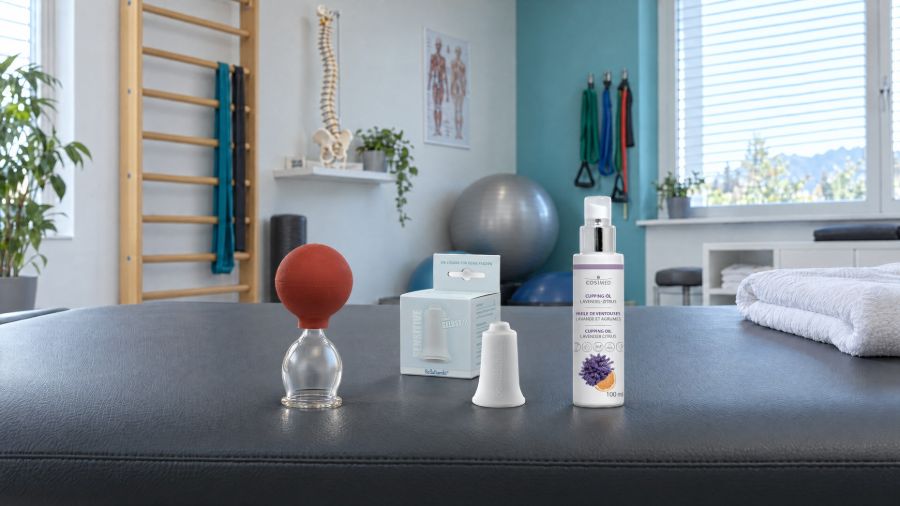
The five products illustrate the designs described and the oil for gliding massage. This selection is not a test or blanket authorisation for self-use. The reasons for the selection:
BellaBambi fascia cup: silicone cup with available self-use instructions and specific skin and care guidance.
GUOYIYAN cupping set: four silicone cups without a separate pump. Use your set's instructions.
AcuTop acrylic cup: suction-bulb model whose manufacturer describes the application sequence; the reference for the diagrams.
AcuTop cupping case: hand-pump system with enclosed instructions. Who may use it, how to release it and how to care for it are governed by those instructions.
cosiMed cupping oil: a product for gliding massage; check the ingredients and the textile warning.
The instructions enclosed with your model are authoritative. The comparison instructions in this guide do not replace them. Available variants and delivery times are listed on the product pages.
Frequently asked questions
Too much suction, leaving cups on too long, using excluded body areas, pulling cups off by force and incorrect reprocessing can cause problems. Have the techniques for your product demonstrated to you. Release the suction immediately if symptoms occur; stronger marks do not mean a better effect.
Among other areas, not on the spine or bony prominences, major vessels, lymph nodes, varicose veins or injured skin. The full list appears before the basic procedure. This guide excludes the head, face, neck, and the front and inner surfaces of the body.
netDoktor describes a few minutes. This is not a minimum time: skin reactions or discomfort mean stopping sooner. The BellaBambi table for cups left in one place is not a massage timetable. Nor can a general frequency for home use be derived from it.
The cup creates negative pressure on the skin. Whether this will relieve your symptoms cannot be predicted reliably. Studies on pain relief are uncertain; they do not establish an effect on organs or a reliable treatment. Have unexplained back pain assessed by a doctor.
A massage or cupping oil suitable according to the cup's instructions helps it glide over the skin. Check the ingredients of the chosen variant. Keep oil away from the bulb: methatec expressly warns of material damage to its PVC bulb. For other products, follow their care instructions.
The professional practice sources cited and Meridius describe fading after a few days; NCCIH notes that longer-lasting discolouration is possible. There is no fixed deadline. Colour establishes neither a diagnosis nor success. Have pronounced or non-fading changes, as well as pain, assessed by a doctor.
pulox and Hwato list pregnancy as an exclusion; BellaBambi requires medical consultation. This guide therefore does not provide instructions for use during pregnancy, including cupping massage. Discuss your individual situation with your doctor and observe the product prohibitions.
Still unsure? Discuss whether cupping is suitable for you and any unexplained symptoms with your doctor. For practical instruction and treatment, find a professional with appropriate training. EMR/ASCA recognition can help with your search; check their qualification for the specific method. saneq can help with questions about products, instructions and availability.
If you would like treatment, ask about the costs beforehand and check with your supplementary insurance provider about coverage and recognition of both the method and your chosen professional. The EMR list of methods includes cupping, but its insurer information is non-binding. Registration alone is not a guarantee of reimbursement.