Safe showers and baths in later life: shower chair, bath board or bath lift?
Which bathing aid suits you and your bathroom? Compare shower chairs, bath boards and lifts, check dimensions and clarify funding in Switzerland.
Published on
·23 min read
Image: saneq
The right bathing aid depends on whether you can stand, sit and get over the edge of the bath safely. Here you can compare showering aids, bath boards, bath seats and lifts by their functions and limits. If you are looking for your mother or father, assess these movements together with them and a professional, and measure the bathroom.
This guide by the saneq editorial team is based on drive instructions for use, documents from Swiss authorities and insurers, and recommendations from BFU and Pro Senectute. The models come from our range; we did not carry out our own practical test. Research: September 2026; the dates of the individual documents are listed in the sources.
Which bathing aid suits your situation?
This table is our guide based on the manufacturers' intended uses. Have your ability to sit, your transfer and your support needs assessed in person, for example by an occupational therapist or an aids advice service. This is particularly important if your abilities have changed.
Your situation
Type of aid to consider
Requirement or limit
Standing in the shower is difficult, but your upper body stays stable when sitting.
Shower stool
Sufficient arm function and sitting stability are required. Dino is unsuitable for people who cannot maintain a sitting position.
Sitting steadily, sitting down or standing up is also difficult.
Shower chair with a suitable backrest and armrests
Assess support needs individually. A backrest alone is not automatically sufficient.
The seat needs to fold up in a shared shower.
Wall-mounted folding shower seat
The wall, fixings and support legs must be suitable; have the seat height determined professionally.
You want to shower while sitting at bath-rim height.
Bath board
Sufficient trunk control and mobility to change position; your legs must be able to pass over the rim.
You are looking for a fixed seat inside the bath.
Suspended bath seat, such as Bob
Suitable support on the rim and sufficient ability to transfer; no motorised height adjustment.
You need a swivelling seat at the bath rim.
Swivel bath seat
Operate the swivel and locking mechanism according to the instructions. A swivel seat does not lower you to the bottom of the bath.
You cannot get into or out of the bath, or sit down and sit up in it, independently.
Bath lift
Assess suitability and assistance with transfers. The lift handles lowering and raising inside the bath.
You are looking for an extra step.
Bath step
A step does not provide a seated transfer. If you are unsteady on your feet, it does not replace a seating aid.
The toilet is too low for you to sit down or stand up comfortably.
Raised toilet seat, with armrests if needed
Check the total seat height and fit on the bowl; the highest version is not automatically suitable.
Shower chairs for older people: what dimensions and supports do you need?
Compare the seat surface with the space you need, and the overall dimensions with your shower. Allow extra room for your legs, movement and, if necessary, someone helping you. W × D means width × depth; an overall dimension does not automatically describe the footprint of the legs.
The values come from the respective instructions for use: Dino dated 14.04.2026, Delphi dated 09.01.2025, Duro KD dated 25.07.2024 and DKS 130 dated 06.03.2022. All dimensions are in cm, load capacity and product weight in kg; the DKS heights have been converted from mm.
Seat height 40–52 cm; seat surface W × D: 50 × 30 cm
Width 53 cm; depth 52–56 cm
130 kg; 3.3 kg
DKS 130, wall-mounted
Seat height 46.5 / 49 / 51.5 / 54 cm; seat surface W × D: 41 × 41 cm
W × D: 48 × 50 cm
130 kg; 4.1 kg
General safety note: do not use a shower seat as a step. Duro KD is described here as an example in versions with and without a backrest. Assess whether the supports provided are sufficient for you, regardless of the model name. Check current availability on the product page.
How do you adjust a freestanding shower seat?
Determine the seat height. Following the approach in the DKS 130 instructions, use an ordinary chair on which you sit comfortably with both feet on the floor. Measure its seat height and compare it with the available settings. If you have difficulty sitting down or standing up, have the appropriate height determined professionally.
Adjust without a load. On Dino, Delphi and Duro KD, press the locking button, slide the leg to the desired height and let the button engage fully. Repeat this on all four legs at the same height.
Check stability. Check the fixings and make sure the seat stands securely in its intended location. Try sitting down and standing up with the support agreed beforehand.
For the wall-mounted DKS 130 folding shower seat, the instructions for use state: “The seat height must be determined and adjusted by a professional.” Also have the wall and fixings checked professionally and the installation carried out accordingly. When folding the seat up or down, hold only the seat plate: risk of trapping. The four-leg instructions above do not apply to this model.
Bath board, bath seat or bath lift: how do you use your bath?
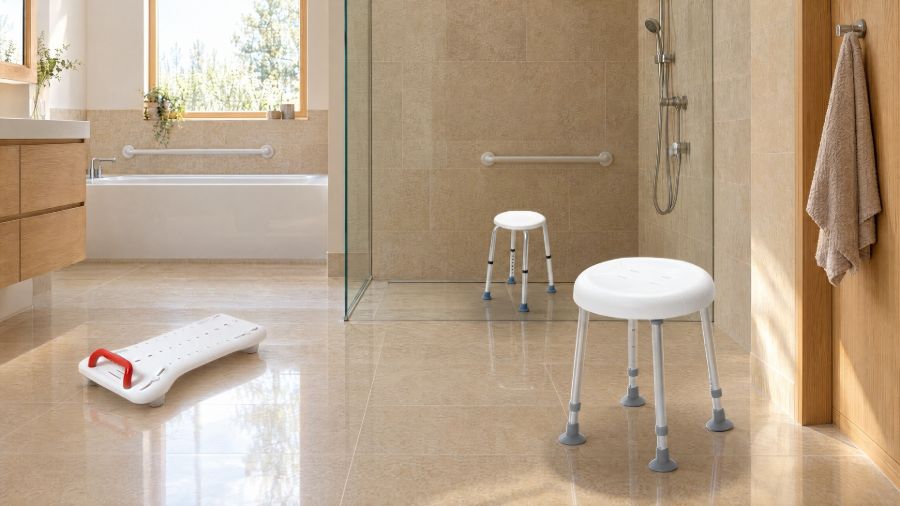
Among bathing aids, a board stays at rim height, while a suspended seat provides a fixed sitting position inside the bath. A swivel seat such as BES 120 rotates the seat; a lift changes its height. The Sky bath step, by contrast, is a step. How deeply you can immerse yourself also depends on the bath, water level and person.
Which bath dimensions do you need to check?
Measure at the actual installation point. Internal width, rim support and base area describe different dimensions. The table uses the instructions for use for Benny dated 24.06.2026, Bob dated 26.06.2023 and NOVA dated 17.12.2025; dimensions in cm, weights in kg.
Seat W × D: 38 × 52.5 cm; seat height above the bath bottom 6.5–48 cm
Overall width 70 cm; base plate W × L: 30/31 × 61 cm. Check space for the backrest and side flaps.
140 kg; 9.5 kg without / 9.9 kg with hand control
If you are considering Benny XL: the instructions for use specify a maximum of 210 kg for the 73 cm version. Do not apply the weight limit of a different board length to this variant.
For Bob, the instructions for use state: “The bath rim must be clean and dry.” Adjust the supports to the widest suitable setting and check that the locking buttons are engaged. Sit down slowly; do not stand on the bath seat. Assembly must be complete before use.
How do you secure and use a bath board?
The following guidance assumes sufficient trunk control and mobility to change position. Before your first attempt, clarify whether you need help and what kind. The assembly and movement sequence are based on the Benny instructions for use and the patient information sheet “Bath board” from Canberra Health Services (2025).
1 Handle towards the wall. 2 Board resting securely on both bath rims. 3 Slide the stop bolts against the inner walls and tighten. 4 Compare the internal width at the installation point with the adjustment range for your board length. The sketch shows the fixing, not transfer instructions.
Image: saneq
Check the assembly and secure fit. Arrange the necessary support.
Sit down slowly on the board from the entry side, initially only on the front edge (narrow side). Both feet stay on the floor outside the bath.
Move backwards while sitting until the backs of your legs touch the bath rim. Hold the handle provided.
Bring your legs over the rim one at a time and turn towards the taps or shower head. Sit in the centre of the board to shower.
Reverse the movement to get out. Place both feet securely on the floor outside the bath before standing up.
What do you need to consider when using a bath lift?
With Bellavita NOVA, safe operation matters as well as fit in the bath. Before first use, read the full instructions and have the installation, transfer and controls demonstrated. The following overview applies exclusively to NOVA, with instructions for use dated 17.12.2025.
Set the transfer height. Once assembly is complete, check that the hand control connector is engaged: the red ring on the plug must not be visible. Switch on and raise the seat. The unfolded side flaps must rest flat on the bath rim; the seat and flaps form a horizontal surface.
Transfer and lower. With the agreed help, sit in the centre of the seat with your back against the backrest and your legs stretched slightly forwards. Press the down button and place your free hand in your lap. Releasing the button stops the movement. If the backrest touches the bath wall, release the down button.
Raise the seat to get out. Raise it back to the appropriate transfer height. Make sure the side flaps do not catch on bath handles and rest horizontally again. Transfer out of the bath with the necessary help and switch off. Then charge the hand control as described above.
Which raised toilet seat fits your toilet?
The key factors are the seat height after installation, your feet touching the floor and the shape of the bowl. Ticco 2G is available in 5, 10 and 15 cm versions, each with or without a lid. The instructions for use dated 22.07.2025 specify a maximum load of 225 kg for all variants.
The variant name does not describe all component dimensions: for Ticco 2G/10 with a lid, the instructions for use state a “front height” of 10 cm and a “rear height” of 14.6 cm. Check the actual seat height on the fitted toilet; do not simply add the variant number to the previous seat height.
For installation, lift the existing toilet seat and lid; according to the instructions for use, they may need to be removed. Place the raised seat on the bowl and secure it as described. Check the fit on the actual toilet.
If you need armrests, have an appropriate solution assessed, such as TSE 120 Plus, mentioned here as an example; check current availability separately. The toileting aids overview also includes other types. A commode chair or shower commode wheelchair needs its own assessment of your equipment needs; find out more in the types of wheelchair guide.
What else makes a bathroom safe?
According to BFU, more than 126 000 fall accidents occur at home every year. The BFU dossier on falls reports more than 1700 deaths per year across Switzerland; 95 % involve people over 64. These figures describe falls in general, not a measured effect of individual bathing aids.
BFU and Pro Senectute recommend the following changes to your bathroom:
Routes and lighting. Keep walkways clear and provide good, glare-free lighting, including on the way to the toilet. Remove loose rugs and trip hazards.
Support points. Have suitable grab rails installed professionally and the required seat determined.
Slip resistance. Consider suitable floor surfaces or anti-slip strips in the shower, in the bath and in front of them. Your aid's installation instructions remain decisive: with NOVA, there must be no mats in the bath; the suction cups need a suitable, clean contact surface.
Alterations. For larger changes, consider a threshold-free shower with a suitable shower seat. Clarify use, structural feasibility and funding in advance.
The bathroom overview brings the aids together. For advice on adapting your home, contact Pro Senectute and SAHB.
Clean and check each aid according to its instructions for use. The simple seating aids described here are cleaned regularly with a damp cloth; harsh products, abrasive cleaners and highly concentrated chlorine or vinegar cleaners are excluded. Do not expose them to temperatures above 60 °C for prolonged periods. NOVA has separate rules for the lift, covers and electrical components: unplug the mains plug before cleaning the hand control or power supply unit. Following the safety instructions in the instructions for use, clean these two parts only with a dry cloth. Do not use cleaners containing acetic acid on the lift. Take defective parts to a specialist retailer for assessment.
Who pays for shower chairs, bath boards and bath lifts in Switzerland?
Shower chairs, shower stools, bath boards, bath seats, bath lifts and raised toilet seats have no corresponding entry in the reviewed FOPH MiGeL as of 1 July 2026. Purchase or rental cannot be funded through this basic health insurance reimbursement route. A prescription alone does not create a MiGeL entitlement. Different conditions apply to supplementary insurance, IV or EL.
Funding route
What may be available
Requirement and next step
Source / date
Basic health insurance / MiGeL
No corresponding MiGeL entry for the bathing and toileting aids covered here.
Even a medical prescription does not establish a MiGeL entitlement here. This statement concerns the aid, not all nursing or therapy services.
Depends on the policy. Dated Helsana document for TOP/OMNIA/COMPLETA: up to CHF 500 towards buying a shower stool, chair or board, including for use in a bath; up to CHF 3'000 for buying or renting a bath lift.
The list requires medical necessity, suitable provision and a medical prescription. The 2018 version is not a promise of benefits under your current policy: clarify this in writing beforehand. Raised toilet seats are not listed there.
No new entitlement for these bathing and toileting aids under the AHV aids list.
Check protection of existing entitlements: if you already received IV aids before the reference age or before drawing your entire old-age pension early, benefits may continue if the IV requirements remain met.
HVI 14.01 covers additions to existing sanitary installations; provided on loan. The KHMI also explicitly mentions bath lifts.
Ordinary entitlement before the reference age or before drawing the entire AHV old-age pension early. The personal hygiene task concerned must be impossible without the aid. Apply to the IV office; assessment by SAHB. No blanket approval for a particular model.
HVI 14.04 covers specified disability-related adaptations to the bathroom, shower and toilet, as well as support rails and additional handles.
A preliminary assessment is necessary before any planning. Clarify the project with the IV office, including consent where the property belongs to someone else. This does not create an entitlement to any bathroom renovation of your choice.
Costs of aids may be considered as illness and disability expenses, provided no other insurance covers them.
Cantonal rules apply. In principle, apply within 15 months of invoicing. These costs may create an entitlement even if you are not currently receiving annual EL; the EL office assesses this.
If you first need this kind of aid at AHV age, Pro Infirmis states that there is practically no entitlement to AHV funding for aids and structural adaptations in the home. This must be distinguished from protection of existing entitlements to earlier IV benefits. Depending on your situation, check EL, supplementary insurance and additional support.
Under IV, a bath lift may also be considered under KHMI 14.01 if it mainly serves a carer and you can contribute only a little to your own personal hygiene; IV assesses the requirements individually.
If you have a lasting impairment, costs you pay yourself for aids may be tax-deductible as disability-related expenses (FTA circular 11a dated 26.05.2026, section 4.3.8; it replaces circular 11 of 2005 from the 2027 tax period). Clarify with your cantonal tax administration whether you meet the requirements.
How do you clarify funding before buying?
Have the appropriate aid, transfer and support needs determined. If you may be entitled to IV benefits, contact your IV office; SAHB carries out the corresponding assessment.
If supplementary insurance benefits may be available, clarify the medical prescription and the current aids list for your policy.
Have responsibility and any potential cost coverage clarified in writing before buying. For structural adaptations under IV, the preliminary assessment starts before planning.
If needed, ask the cantonal EL office and Pro Senectute or Pro Infirmis about additional support.
Consider a regional rental or trial option if you want to check fit and handling first.
The following six models illustrate the types described. You can find variants, current prices and availability on the product pages.
Dino: stool with a smaller seat surface in the comparison shown; requires stable sitting.
Delphi: stool with a different seat height, larger seat surface and higher weight limit than Dino.
Benny: board for sitting at bath-rim height; the appropriate length depends on internal width and support on the rim.
Bob: fixed suspended seat inside the bath, with or without a backrest.
Bellavita NOVA: lift for lowering and raising in the bath; transfers and supervision still need individual assessment.
Ticco 2G: example of a raised toilet seat in different versions.
What questions about bathing aids come up frequently?
The shower chairs discussed here are not listed in the reviewed MiGeL as of 1 July 2026. This basic health insurance route does not create an entitlement. Supplementary insurance may provide contributions under its policy; clarify this in writing before buying, with a medical prescription if required.
Discuss the medical need with your GP practice. A medical prescription may be required for supplementary insurance, as in the dated Helsana example. The prescription does not replace checking the policy and does not, by itself, create a MiGeL entitlement.
You can consider a stool, a chair with the supports you need or a wall-mounted folding seat. The deciding factors are your ability to stand and sit, to sit down and stand up, and the space in your shower. If your sitting stability is insufficient, you need an individual assessment.
Consider a threshold-free shower, a suitable seat, professionally installed grab rails and appropriate slip resistance. Have structural suitability and your support needs assessed. Any potential IV funding under HVI 14.04 must be clarified before planning begins.
Clarify which movement is difficult: rising from a low seat or transferring over the bath rim. A lift raises the seat; a board and a fixed bath seat maintain a particular sitting position. Even with an aid, assistance with transfers and supervision may be necessary.
First check fit, secure positioning and your need for help. The instructions above describe sitting down slowly and changing position; pay particular attention to the risk of slipping with soapy water. On Benny, the handle must face the wall. Never stand on the board.
A bath lift is not included in the reviewed MiGeL. As an explicitly dated example, the Helsana supplementary insurance list of 1 April 2018 specifies up to CHF 3'000 for buying or renting a bath lift, subject to its conditions. Check your current policy. Before the reference age, an IV assessment under HVI 14.01 may also be an option; this does not amount to approval for your case.
Still unsure? An occupational therapist or SAHB can assess your abilities, transfers and home environment with you; Pro Senectute helps with further questions about housing in later life. saneq answers product questions about dimensions, variants and availability in medical supplies.
The guide “Who pays for a wheelchair?” explores funding routes in more detail using wheelchairs as an example. Its specific contributions and eligibility rules cannot be applied to bathing aids.
The route from the bedroom to the bathroom is also part of the planning: the guide “Rollators for the home” shows which mobility aids suit confined spaces.